
Imagine a delivery truck miscalculates a backup at your Everett loading dock, leaving a gaping hole in your facility’s security and a bottleneck in your workflow. When a vehicle or forklift impact occurs, your immediate concern isn’t just the dent. It’s the structural stability of the system and the safety of your team. Professional commercial garage door collision repair is about more than just aesthetics; it’s a critical response to a mechanical failure that can halt operations and create significant liability under the OSHA General Duty Clause.
You’re likely balancing the need for a quick fix with the reality of a tight maintenance budget. We understand that a door that won’t close is a direct threat to your bottom line and facility safety. This guide will teach you how to accurately assess damage, minimize expensive downtime, and determine when a panel repair is sufficient versus when a full replacement is necessary. We’ll walk through a clear cost-benefit analysis to ensure your Washington facility remains secure, compliant, and fully functional.
Key Takeaways
- Secure the site immediately using lockout/tagout procedures and safety perimeters to prevent secondary injuries or further mechanical strain.
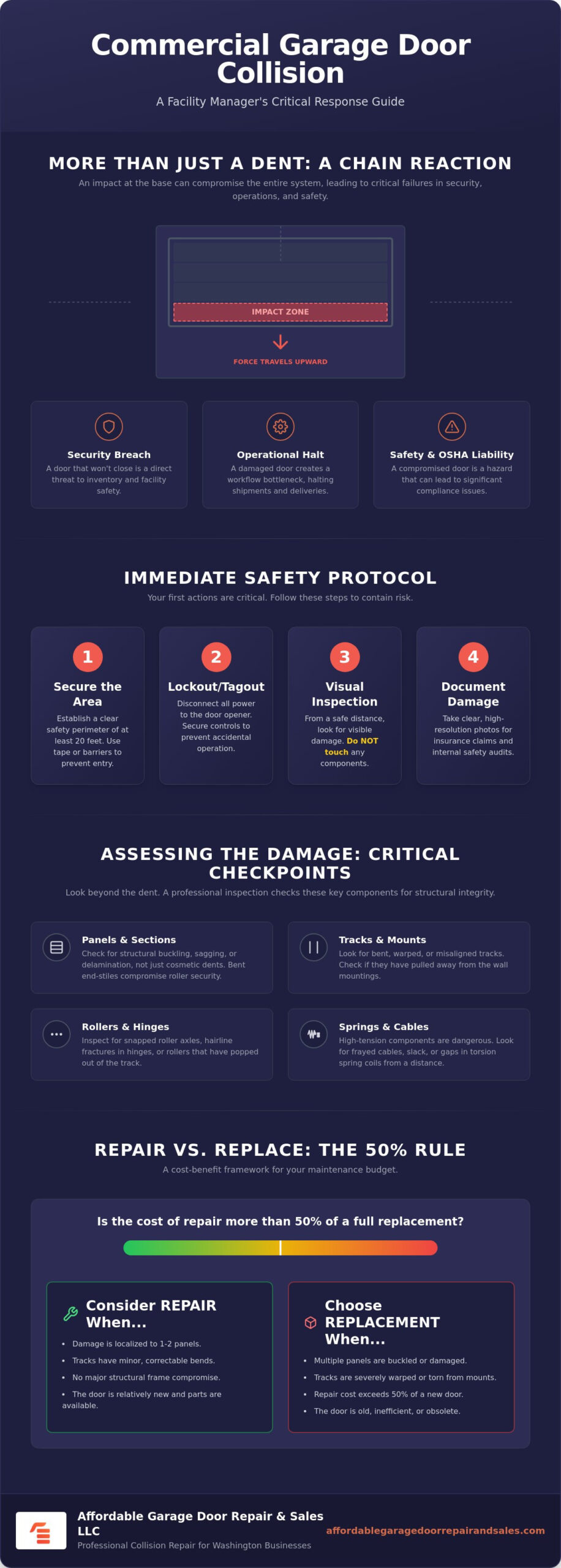
- Understand the “chain reaction” effect where a bottom-panel impact can compromise top rollers and tracks, making professional commercial garage door collision repair essential for structural integrity.
- Apply the “50% Rule” to evaluate whether repairing damaged sections or investing in a full replacement is the most cost-effective path for your facility’s budget.
- Utilize local Washington service hubs for precision track realignment and rapid emergency response to minimize costly operational downtime.
Immediate Steps After a Commercial Garage Door Collision
The moment a forklift or delivery truck strikes a garage door, the clock starts ticking on both safety and operational costs. Your first priority isn’t the repair; it’s the containment of risk. Establish a clear safety perimeter around the affected area immediately. Use safety tape or physical barriers to keep employees and pedestrians at least 20 feet away from the opening. A damaged door is under immense tension from the springs and cables; a single failed component could cause the entire assembly to fall without warning.
Next, implement a strict lockout/tagout procedure. Disconnect the power to the door opener and secure the controls to ensure no one attempts to operate the system remotely. Attempting to cycle a door with bent tracks or misaligned panels can burn out the motor or cause the door to jump the tracks entirely. This step is a critical part of managing a commercial garage door collision repair event safely.
Perform a preliminary visual inspection from a safe distance. Don’t touch any of these components, but look for the following indicators of structural damage:
- Frayed or slack cables that have lost tension.
- Gaps or breaks in the torsion spring coils.
- Tracks that have pulled away from the wall mounting or the floor.
- Bent hinges or rollers that have popped out of the track.
Securing the Area and Preventing Further Damage
It’s tempting to try and force a slightly hit door back into its tracks to keep the facility moving. This is a dangerous mistake. Forcing the door can warp the tracks beyond repair or snap a cable, turning a simple commercial garage door collision repair into a full system replacement. Instead, focus on clearing a path for the technician’s vehicle to reach the loading dock. If the door is stuck in the open position, you may need to station a security guard or move high-value inventory to a secure area of the warehouse until the technician arrives.
Documenting Damage for Insurance and Safety Audits
Before any parts are moved or temporary fixes are attempted, document everything. Take clear, high-resolution photos of the track alignment, hinge points, and cable tension. These photos are vital for insurance claims and internal safety audits. Identify the specific vehicle or piece of equipment involved in the collision to help with internal safety reporting and root cause analysis. This documentation provides a baseline for the repair team to understand the force of the impact. For businesses in Snohomish County, calling for emergency garage door repair Everett is the fastest way to restore security and begin the formal restoration process.
Assessing Collision Damage: Critical Components to Check
A vehicle impact triggers a structural chain reaction throughout the entire door assembly. While the most visible damage usually occurs at the point of contact, the force travels upward through the hinges and rollers to the top of the door. This energy transfer can bend the roller stems or cause the top sections to pull away from the header. When managing commercial garage door collision repair, a facility manager must look beyond the dented panel to understand how the system’s geometry has changed. Even a quarter-inch shift in the vertical tracks can lead to a catastrophic door fall, creating a life-safety hazard that violates OSHA’s General Duty Clause.
Hinges and rollers are the backbone of a sectional door’s structural integrity. During a collision, these components often absorb the shear force, leading to hairline fractures in the metal or snapped roller axles. If the rollers are no longer seated deeply within the track, the door is at risk of jumping out of position during its next cycle. Additionally, the cables and springs remain under high tension even after a hit. An impact can cause a cable to slip off its drum or fray, which leaves the door’s full weight unsupported and ready to drop at any moment.
Structural Integrity of Sectional and Roll-Up Panels
Distinguishing between cosmetic dents and structural buckling is a vital skill for any facility manager. A cosmetic dent affects the appearance but doesn’t hinder the movement of the door. Structural buckling, however, often involves the end-stiles. If these vertical supports are bent, the panel loses its rigidity and can no longer hold the rollers securely in the track. This is particularly problematic for insulated doors, where the internal foam core may delaminate from the steel skin, causing the panel to “smile” or sag in the middle. Such damage usually necessitates a panel replacement to restore the door’s wind-load rating and safety standards.
Hidden Mechanical Stress in Tracks and Openers
Mechanical stress often hides in the track brackets and wall mountings. A hit from a forklift can pull the mounting lag bolts out of the wood or steel jambs, making the entire system unstable. The opener system is also vulnerable; if the door is misaligned, the motor trolley will experience excessive friction as it pulls against the resistance. A track-shifting collision can bind the entire assembly, which explains why your garage door won’t open manually even after the motor is disconnected. Continued use in this state will eventually burn out the motor capacitor or strip the internal gears. To prevent these cascading failures, scheduling a professional assessment with Affordable Garage Door Repair & Sales LLC is the most reliable way to ensure your facility remains operational and safe.
Repair vs. Replace: A Decision Framework for Facility Managers
Deciding whether to authorize a commercial garage door collision repair or invest in a full replacement requires a balance of immediate budget concerns and long-term facility safety. We recommend using the “50% Rule” as a primary benchmark. If the estimated cost to restore the door to its original safety and wind-load specifications exceeds half the price of a new garage door installation Washington, replacement is usually the more fiscally responsible path. This rule accounts for the fact that a heavily repaired door often requires more frequent maintenance and may have hidden structural weaknesses that shorten its remaining lifespan.
Safety and liability are the next critical factors. For public-facing businesses or high-traffic warehouses, a door that has suffered significant structural compromise is a risk that doesn’t belong on your balance sheet. While a quick fix might get the door moving, it won’t necessarily restore the door’s ability to withstand high winds or prevent a secondary mechanical failure. Additionally, navigating commercial insurance claims for vehicle-into-building accidents often hinges on whether the repair returns the facility to its pre-accident safety standard. Insurance adjusters are more likely to approve a full replacement if a certified technician documents that the door’s structural integrity can’t be guaranteed through repairs alone.
When Panel Repair or Replacement is Sufficient
A panel-only repair is the most efficient choice when the impact was low-speed and localized. If the damage is confined to a single section and the vertical tracks remain plumb, swapping out the damaged panel can restore full functionality within hours. We focus on matching older door styles and colors to maintain your facility’s professional appearance. However, this approach only works if the internal hinges and end-stiles are intact. Before installing new panels, our technicians perform a precision alignment check to ensure the existing tracks won’t cause premature wear on the new components.
Signs You Need a Full Commercial Door Replacement
Full replacement becomes necessary when the impact forces have twisted both the vertical and horizontal tracks or damaged multiple sections beyond the point of safe operation. Obsolescence is another major factor; if your door model is no longer manufactured, finding compatible replacement panels may be impossible. In these cases, a new installation is the only way to ensure compliance with modern safety standards. Many Washington facility managers use this as an opportunity to upgrade to high-impact resilient models or full-view glass doors that improve natural lighting and employee morale while providing better durability against future incidents.
The Professional Collision Repair Process
Executing a commercial garage door collision repair requires a level of technical precision that goes far beyond standard maintenance. Once the initial damage assessment is complete, the physical restoration begins with the foundation of the system: the tracks. Technicians use professional-grade hydraulic tools to push and pull twisted steel back into alignment. This isn’t a job for hammers and pry bars, which can leave permanent kinks in the metal. Instead, controlled hydraulic pressure ensures the track returns to its original profile, allowing the door to glide without friction or binding.
Section replacement is the next critical phase. This technical process involves “stacking” new panels into the existing system. Our technicians carefully remove the damaged sections while supporting the weight of the remaining door. The new panels are then slotted into place and secured with heavy-duty hinges. Because even slight manufacturing variations can affect performance, we verify that the new sections integrate perfectly with the existing weatherstripping and end-stiles to maintain the door’s thermal envelope and security.
Every collision repair must conclude with a spring tension recalibration. When panels are replaced or tracks are straightened, the balance of the door shifts. A door that is even slightly out of balance puts immense strain on the opener and cables, leading to premature failure. We perform a balance check to ensure the torsion springs provide the exact amount of lift required to make the door feel weightless during manual operation. Finally, we test the opener logic and safety sensors to confirm the automated system reacts correctly to obstructions, ensuring full compliance with industrial safety standards.
Restoring Track and Roller Alignment
Maintaining a “plumb and square” standard is non-negotiable for commercial operations. If the tracks are tilted or the horizontal radius is slightly off, the door will eventually “walk” out of its tracks. During the repair, we often replace standard rollers with heavy-duty industrial alternatives that feature sealed bearings and reinforced stems. These components are better equipped to handle the vibrations of a high-traffic warehouse. We also verify that the track radius hasn’t been compromised, as a flattened curve can cause the door to jerk or stall as it transitions from vertical to horizontal movement.
Final Safety Inspections and Load Testing
The repair isn’t finished until the system passes a rigorous garage door safety inspection. We cycle the door multiple times, testing both the motor-driven operation and manual override. This ensures the disconnect mechanism works perfectly in the event of a power failure. We also verify the integrity of the bottom seals and weatherstripping, which are often torn during a collision. These seals are vital for climate control and preventing pest ingress. If your facility has suffered an impact, don’t leave your security to chance. Contact Affordable Garage Door Repair & Sales LLC today for a professional restoration that returns your door to peak performance.
Why Local Expertise Matters for Washington Businesses
When a facility faces a crisis, a national dispatch center cannot match the speed or regional knowledge of a local partner who understands the I-5 and I-90 corridors. Local expertise is the foundation of effective commercial garage door collision repair. Because we maintain fully stocked service hubs in Everett, Spokane, Yakima, and Pasco, our technicians arrive with the specific parts needed for industrial sectional and roll-up doors. This local inventory eliminates the long lead times often associated with shipping heavy panels or specialized track hardware from out-of-state warehouses.
Washington’s geography creates unique mechanical challenges that a one-size-fits-all approach misses. Western Washington’s consistent humidity and salt air require hardware with high corrosion resistance to prevent premature rust after a repair. In contrast, the extreme temperature swings of the Inland Empire and Central Washington demand high-performance thermal seals and specific lubricants that won’t seize in sub-zero winters or melt in triple-digit summers. A local expert ensures that every repair is calibrated for the specific environment where your facility operates, protecting your long-term investment.
Building a partnership with a local provider also simplifies the transition from emergency support to preventative maintenance. We don’t just fix the immediate damage; we help you develop a strategy to prevent future incidents. This includes identifying high-risk traffic patterns in your warehouse and recommending high-visibility upgrades or reinforced bottom sections. By working with a team that has a vested interest in the Washington business community, you gain a proactive ally dedicated to your facility’s safety and uptime.
Serving Everett, Seattle, and the Greater Puget Sound
Logistics in the Seattle area are notoriously difficult due to heavy traffic and constrained loading zones. Our headquarters in Everett allows for rapid deployment across Snohomish and King Counties, ensuring that a collision at a Tacoma distribution center or an Auburn warehouse doesn’t stall your entire supply chain. We understand the urgency of securing a port-side facility or a high-security downtown garage. Our teams are familiar with the local access requirements and dock configurations common in the Puget Sound, allowing us to begin the commercial garage door collision repair process while others are still checking a map.
Comprehensive Coverage from Yakima to Spokane
The agricultural and industrial hubs of Central and Eastern Washington require a different set of priorities, particularly regarding weather-sealing and dust mitigation. For example, garage door repair Yakima often involves specialized seals to protect sensitive produce or equipment from the fine volcanic soil and extreme winds of the region. Our regional offices provide the same high-standard service found in our coastal hubs, tailored to the needs of local growers and manufacturers. We invite you to contact our nearest regional office to schedule a free on-site estimate and experience the stability of a truly local service partner.
Restoring Safety and Efficiency to Your Facility
A vehicle impact is a significant disruption, but it doesn’t have to be a permanent setback for your operations. By prioritizing immediate site safety and applying a clear decision framework for repair versus replacement, you protect both your budget and your employees. A professional commercial garage door collision repair is a structural restoration that ensures your facility remains compliant with safety standards and resilient against Washington’s diverse climate. We’ve explored how identifying hidden mechanical stress early can prevent costly motor failures and secondary accidents.
Our team of certified industrial technicians is ready to help you navigate the recovery process with minimal business interruption. We provide 24/7 emergency service and maintain a local presence to serve all of Washington State, from the Puget Sound distribution centers to the industrial hubs of Spokane. We’re committed to being your dependable local partner for long-term functional results.
Get a Free On-Site Estimate for Your Commercial Collision Repair
Let’s get your loading docks back to full capacity so you can focus on your core business goals with total peace of mind.
Frequently Asked Questions
Is a commercial garage door safe to use after a minor vehicle hit?
No, you should avoid operating the door until a professional technician performs a structural safety audit. Even a minor impact can shift the vertical tracks or fray high-tension cables, creating a risk of the door falling unexpectedly. It’s best to implement lockout/tagout procedures immediately to prevent accidental use by employees or automated opener systems.
How much does commercial garage door collision repair typically cost?
The total cost depends on several variables, including the door’s material, the number of damaged sections, and whether the tracks require hydraulic realignment. A simple panel swap is less involved than a full system restoration involving springs and openers. We provide free on-site estimates to give you an accurate assessment based on your facility’s specific hardware and safety requirements.
Can I replace just one panel of my commercial garage door?
Yes, single-panel replacement is a standard part of commercial garage door collision repair when the damage is localized. This approach is highly effective for low-speed forklift impacts that haven’t twisted the main vertical tracks. We focus on matching the existing section’s color and insulation type to maintain your building’s professional appearance and energy efficiency.
How long does it take to repair a door after a forklift collision?
Most essential repairs, such as track realignment or roller replacement, can be completed within two to four hours once the technician is on-site. If specialized panels need to be ordered from the manufacturer, the timeline may extend. Our priority is always to get the door into a safe, closed, and secure position during the first visit to protect your inventory.
Will my business insurance cover garage door collision damage?
Most commercial property insurance policies or the vehicle’s liability insurance will cover building damage caused by a collision. You’ll need to provide your provider with a detailed repair estimate and photographic evidence of the impact. We recommend checking your specific policy for deductibles and any requirements for using certified repair contractors.
What should I do if my commercial door is stuck half-open after an accident?
You must secure the area with a safety perimeter and avoid trying to move the door manually. A door stuck in mid-travel is often held by a single cable or a binding track, making it extremely unstable. Contact an emergency technician immediately to stabilize the system and prevent a total collapse that could cause serious injury or property damage.
Why is my commercial door making a loud grinding noise after a collision?
Grinding noises typically signal that the rollers are struggling to move through a bent or misaligned section of the track. This friction puts excessive load on the opener’s motor and can lead to a complete mechanical failure. Stop using the door immediately, as continued operation often results in snapped cables or a burned-out motor capacitor.
Do you offer emergency 24/7 repair for warehouse doors in Washington?
Yes, we provide 24/7 emergency commercial garage door collision repair across the entire state. With service hubs in Everett, Spokane, Yakima, and Pasco, our teams can respond quickly to loading dock emergencies at any hour. This rapid response is critical for maintaining warehouse security and minimizing the costs associated with operational downtime.