Your commercial garage door is likely the largest moving part in your entire facility, yet it’s often the most overlooked component of your safety protocol. It’s natural to feel a sense of anxiety regarding workplace accidents or the sudden, costly downtime that follows a mechanical failure. You need your operations to remain stable and your employees to stay protected, but managing the overlap between OSHA’s General Duty Clause and the latest DASMA standards can feel overwhelming. We understand that you value long term functional results over temporary fixes and want a partner who prioritizes precision and safety.
This guide provides a comprehensive framework for a commercial garage door safety inspection designed to protect your business and your bottom line. By following these structured steps, you can ensure compliance with 2026 regulations while significantly extending the lifespan of your expensive assets. We’ll preview the critical 13 point checklist for fire rated doors, explain the specific April 2026 Washington state requirements for cargo door counterweights, and show you how a proactive maintenance schedule can prevent up to 80% of emergency breakdowns. You’ll gain the clarity needed to transform a complex mechanical requirement into a dependable safety asset.
Key Takeaways
- Understand how a routine commercial garage door safety inspection can prevent 80% of emergency breakdowns and significantly lower your long-term operational costs.
- Master the “Block Test” and other visual assessment techniques to verify your facility’s compliance with UL 325 and DASMA safety standards.
- Learn to recognize the warning signs of high-tension component failure, such as frayed cables or rusted torsion springs, before they cause workplace accidents.
- Discover the specific 2026 Washington state requirements for cargo doors and fire-rated assemblies to ensure your documentation is ready for local inspectors.
- Transition from calendar-based to cycle-based maintenance schedules to better protect your heavy-duty sectional and roll-up door assets.
Why Commercial Garage Door Safety Inspections Matter in 2026
Maintaining a high-volume facility requires a constant balance between daily output and long-term safety. Your overhead doors are critical assets that facilitate this flow, yet they’re often the most neglected mechanical systems in the building. Ignoring a routine commercial garage door safety inspection doesn’t just invite mechanical failure; it creates a vulnerability in your entire operational chain. While standard repairs typically range from $150 to $800, a total system collapse can lead to catastrophic expenses when you factor in structural damage and lost productivity.
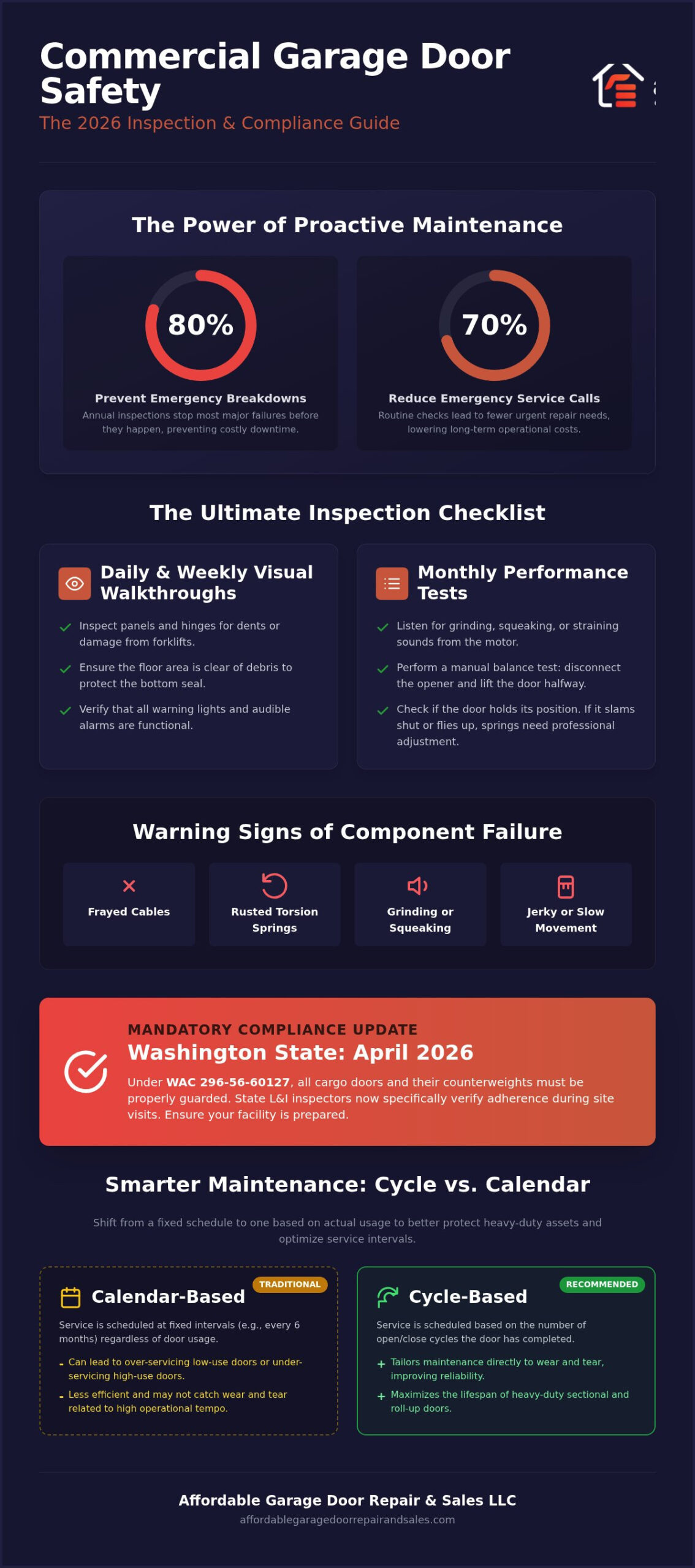
Compliance standards have become more rigorous to address these risks. Washington State has introduced specific updates for the current year. Under WAC 296-56-60127, which became effective April 20, 2026, businesses must ensure that cargo doors and their counterweights are properly guarded. While OSHA relies on the General Duty Clause to mandate a safe workplace, state-level Labor & Industries (L&I) inspectors specifically look for adherence to these newer safety protocols during site visits.
Geography also dictates your maintenance needs. In Seattle and Everett, persistent humidity and salt air accelerate oxidation on rollers, tracks, and fasteners. Conversely, facilities in Spokane or Pasco face extreme temperature swings. These freezing winters cause metal components to contract and lubricants to thicken, which places immense strain on torsion springs. Without a professional assessment, these environmental stressors lead to premature hardware fatigue that standard visual checks might miss.
Reducing Liability and Insurance Premiums
Documented maintenance is your primary defense against personal injury claims and liability disputes. Professional inspection logs provide tangible proof that you’ve met the duty of care required by law. Many insurance providers now offer more favorable commercial rates to property managers who maintain consistent service records. Adhering to the ANSI/DASMA 105 standard provides a recognized benchmark for Garage Door Safety, ensuring your facility meets industry-wide expectations for mechanical integrity and employee protection.
Protecting Inventory and Operational Uptime
When a door fails, your logistics stop immediately. A stuck door can trap delivery vehicles or leave sensitive inventory exposed to the elements. Research indicates that annual maintenance can prevent 80% of emergency breakdowns and reduce emergency service calls by 70%. It’s vital to identify “near-miss” signals, such as frayed cable strands or jerky movement, before they escalate. A proactive inspection secures the building envelope against unauthorized access and keeps your shipping schedules on track, providing the stability your business needs to thrive.
The Ultimate Commercial Door Inspection Checklist
A thorough commercial garage door safety inspection is a layered strategy that begins with simple, consistent observations. By segmenting your checks into daily, weekly, and monthly tasks, you can identify minor hardware fatigue before it results in a total system failure. This structured approach ensures that every component, from the heavy duty tracks to the smallest mounting bracket, remains in peak condition. Start your inspection with an auditory check. Listen for grinding, squeaking, or straining sounds while the motor is running. These noises often indicate that the motor is overcompensating for a mechanical obstruction or that the rollers have reached the end of their functional lifespan.
Daily and Weekly Visual Walkthroughs
High traffic environments often suffer from incidental collision damage that can compromise the door’s structural integrity. You should inspect panels and hinges daily for dents caused by forklifts or pallet jacks, as even minor misalignments can strain the drive system. Ensure the floor area beneath the door is clear of debris. Small stones or wood scraps can damage the bottom weatherseal, which leads to energy loss and potential pest entry. You must also verify that all warning lights and audible alarms are fully functional to alert staff whenever the door is in motion.
Monthly Operational Performance Tests
Every month, perform a manual balance test to evaluate the tension of your springs. After disconnecting the opener, lift the door halfway; it should stay in place without drifting. If it slams shut or shoots upward, the torsion springs require professional adjustment. Observe the travel speed for any inconsistencies or “jerking” movements. These symptoms often point to dust buildup in the tracks or a lack of proper lubrication on the rollers and hinges. Cleaning out these tracks monthly prevents the friction that leads to premature cable wear.
Hardware integrity is the final pillar of a secure facility. Regularly check that all bolts and mounting brackets are tight, as the vibration from daily cycles can loosen even the most durable fasteners. Consistent maintenance is especially vital for businesses following specific OSHA regulations for cargo doors, which mandate secure guarding for counterweights and vertically operated doors. If your visual assessment reveals fraying cables or rusted components, it’s safer to pause operations and seek expert assistance. For a comprehensive review of your system’s health, you can schedule a professional safety inspection to ensure every component meets the 2026 compliance standards.
Testing Critical Safety Mechanisms and Sensors
Modern automated systems rely on a complex network of sensors to prevent workplace injuries. During a professional commercial garage door safety inspection, verifying UL 325 compliance is the first priority. This standard ensures that your openers include essential entrapment protection, such as photo-eyes or sensing edges, which stop the door’s downward travel if an object is detected. These requirements have their roots in the CPSC Final Rules for Openers, which established the federal mandate for automatic reversal systems. While commercial doors are significantly heavier than residential models, the underlying safety principles remain the same. The door must be able to detect and react to obstructions instantly. Ensuring these systems are calibrated correctly protects your staff and prevents damage to your equipment or inventory.
The Reversal and Obstruction Test
The “Block Test” is widely considered the industry gold standard for verifying the auto-reverse mechanism. To perform this test safely, place a 2×4 piece of wood flat on the ground directly in the door’s path. When you activate the close cycle, the door should reverse the moment it touches the wood. If the door continues to press down or strains against the block, your force settings are likely too high. Force settings act as the motor’s internal governor. If these are set too high, the motor will continue to push even when an obstruction is present, which can burn out the drive system. A door that fails this test poses a severe crushing hazard. You shouldn’t ignore a sluggish reversal. If the system doesn’t respond immediately, you should switch to manual operation until a qualified technician can recalibrate the motor’s sensitivity.
Safety Edge and Sensing Technology
Photo-eyes require precise alignment to maintain a steady signal across the door opening. You should regularly clean the lenses with a soft, dry cloth to prevent dust or debris from triggering false reversals. Signal breaks should stop the door immediately. Modern facilities are increasingly adopting sensing edges, which are pneumatic or electric strips attached to the bottom of the door. These provide a secondary layer of protection by triggering an immediate stop upon physical contact. Regularly check the rubber casing on sensing edges for cracks or tears. In the Pacific Northwest, moisture can seep into damaged edges and cause electrical shorts or inconsistent performance. If you use wireless sensing edges, check the batteries every six months to ensure consistent communication with the opener. Integrating smart upgrades into your system allows for real-time safety monitoring, sending alerts to your mobile device if a sensor is blocked or misaligned. This proactive data helps you manage your facility’s security and safety without constant manual oversight.
When to Call a Professional: High-Risk Components
While the daily walkthroughs discussed earlier build a strong safety foundation, certain mechanical tasks are strictly for specialists. A commercial garage door safety inspection often uncovers issues within the “Danger Zone,” which includes any component under extreme tension. Attempting to adjust these parts without proper training can result in severe injury or structural damage. Professionals use advanced diagnostic tools like infrared sensors to detect heat buildup in motors and cycle count tracking to predict part failure before it happens. This technical precision ensures your facility remains operational without the risk of a sudden, catastrophic failure.
Torsion Spring and Cable Safety
Commercial torsion springs are engineered to counterbalance hundreds of pounds. They’re typically rated for approximately 10,000 cycles, though high traffic facilities often upgrade to 50,000 or 100,000 cycle variants to reduce maintenance frequency. You should never attempt to adjust or replace these springs yourself. Warning signs of “spring fatigue” include visible gaps in the coils or a door that feels heavy when operated manually. If you notice even a single frayed strand on a lift cable, the system’s integrity is already compromised. Addressing these issues immediately through expert broken garage door spring repair is the only way to ensure your facility remains a safe environment for your team.
Professional Maintenance Schedules
Determining the right frequency for your service depends largely on your daily usage rather than just the calendar. While a standard warehouse might only need an annual check, a distribution hub with over 50 cycles per day often requires quarterly or even monthly visits. A professional commercial garage door repair tune-up includes more than just lubrication. Technicians perform a comprehensive 13 point checklist for fire rated doors and verify all electrical connections. This process creates a vital paper trail for safety compliance and insurance audits. Maintaining these records proves your commitment to workplace safety and can help lower your liability risks.
If your door fails an internal check or shows signs of hardware fatigue, don’t wait for a total breakdown that halts your logistics. You can secure your facility by scheduling a professional commercial garage door safety inspection today to keep your operations running smoothly and safely.
Commercial Safety Inspections in Washington State
Washington’s diverse geography demands a specialized approach to facility maintenance. A commercial garage door safety inspection isn’t a one-size-fits-all procedure; it must be tailored to the specific environmental stressors of your region. Whether you manage a high-traffic distribution center in the Puget Sound or an agricultural warehouse in the Yakima Valley, your doors face unique wear patterns. We provide localized expertise that ensures your hardware remains resilient against the elements while staying fully compliant with state-level L&I requirements. Our teams offer customized maintenance plans that prioritize your operational uptime and the long-term safety of your employees.
Serving the Puget Sound and Eastern Washington
Our presence across the state allows us to respond quickly to the needs of diverse industrial corridors. In the Seattle, Tacoma, and Bellevue areas, we focus on mitigating the effects of persistent moisture and salt air that can lead to hardware oxidation. For businesses in the Spokane region, our inspections prioritize the structural integrity of systems facing extreme winter temperature swings and heavy snow loads. We also support the vital agricultural facilities in Yakima, Pasco, and Ellensburg. These locations often deal with heavy dust and grit that can infiltrate tracks and rollers, leading to premature motor strain if not addressed through regular professional cleaning and lubrication.
The Affordable Garage Door Repair & Sales Difference
We pride ourselves on being a dependable community partner and a versatile expert in the field. Our technicians are highly trained to understand the nuances of Washington commercial codes, ensuring your facility is always prepared for an official audit. If a commercial garage door safety inspection reveals a critical failure that compromises your building’s security, we provide 24/7 emergency garage door repair to restore your operations instantly. This rapid response capability is a cornerstone of our commitment to your business’s stability and peace of mind.
We believe in providing value through precision and transparency. Every service starts with a clear assessment of your system’s current health and a discussion of the most durable solutions available. If your existing hardware has reached the end of its functional life, we offer free on-site estimates for safety upgrades and new garage door installation. By choosing a partner that understands the specific functional needs of Washington businesses, you’re investing in the longevity and resilience of your facility’s most important mechanical assets.
Securing Your Facility’s Operational Future
Maintaining a safe and efficient workplace requires more than just reactive fixes. By implementing a structured commercial garage door safety inspection framework, you protect your employees and your bottom line from the high costs of sudden mechanical failure. We’ve explored how consistent visual checks combined with professional testing of UL 325 sensors can prevent 80% of emergency breakdowns. Whether you’re navigating the moisture-heavy climate of Everett or the extreme winters in Spokane, specialized maintenance is the key to long-term asset resilience.
Don’t leave your facility’s security to chance. Our team provides 24/7 emergency service across Washington and offers expertise in both OSHA and DASMA compliance to keep your business running smoothly. Schedule Your Professional Commercial Safety Inspection Today and take advantage of our free on-site estimates. We’re ready to help you build a more stable, secure, and productive workplace for years to come.
Frequently Asked Questions
How often does a commercial garage door need a safety inspection?
The frequency of your service depends on daily usage cycles rather than just the calendar. High-traffic facilities in Seattle or Tacoma with over 50 cycles daily should schedule monthly inspections to prevent mechanical fatigue. Standard warehouses usually require at least one professional check per year. Fire-rated doors specifically mandate an annual NFPA 80 inspection to remain compliant. Transitioning to cycle-based maintenance helps prevent 80% of emergency breakdowns and extends equipment life.
What are the OSHA requirements for commercial garage door safety?
OSHA enforces safety through the General Duty Clause, which requires employers to maintain a workplace free from recognized hazards. While they don’t provide a specific garage door checklist, they expect all mechanical systems to be in safe working order. In Washington, L&I mandates specific guarding for counterweights and securing vertically operated doors under WAC 296-56-60127. This regulation became effective April 20, 2026, and is a primary focus for local inspectors.
Can I perform a commercial garage door safety inspection myself?
You can perform basic visual walkthroughs and monthly operational tests, but a comprehensive commercial garage door safety inspection requires a professional for high-risk components. Tasks involving torsion springs, cables, and motor recalibration are dangerous for untrained staff. Our technicians in Everett and Spokane use specialized diagnostic tools to identify hardware fatigue that isn’t visible to the naked eye. Professional documentation also provides a vital paper trail for your insurance provider.
What are the signs that my commercial garage door springs are failing?
You should look for visible gaps in the spring coils, frayed lift cables, or a door that struggles to open evenly. If the door feels exceptionally heavy during manual operation or makes loud grinding sounds, the springs are likely nearing their cycle limit. Since these parts are under extreme tension, you should contact a specialist in Auburn or Puyallup for immediate broken spring repair. Prompt attention prevents the sudden snapping that causes workplace accidents.
Does a commercial garage door need a specific type of photo-eye sensor?
Commercial openers must be UL 325 compliant, which requires monitored entrapment protection like photo-eyes or sensing edges. In damp climates like Seattle or Everett, we recommend NEMA 4 rated sensors that resist moisture and dust infiltration. These sensors must trigger an immediate reversal if the signal beam is broken. Modern smart upgrades can also send real-time alerts to your mobile device if a sensor becomes misaligned, ensuring your facility stays secure at all times.
What should I do if my commercial door fails the auto-reverse test?
Stop using the door immediately and switch it to manual operation to prevent crushing hazards. A failed “Block Test” indicates that the motor force settings are too high or the reversal mechanism is malfunctioning. Because this failure compromises facility security and employee safety, you should call for emergency 24/7 repair. Our teams in Yakima and Pasco can recalibrate these systems to restore full compliance and protect your inventory from accidental damage.
How long does a professional commercial safety inspection take?
A standard professional inspection typically takes between 45 and 90 minutes per door, depending on the complexity of the system. This process includes a 13-point checklist for fire doors and a thorough assessment of all mounting brackets, rollers, and tracks. Technicians in Wenatchee or Ellensburg provide a detailed report afterward. This documentation serves as tangible proof of your commitment to safety, which is often required for insurance renewals and state-level audits.
Are there specific safety rules for roll-up doors vs. sectional doors?
Both styles require a commercial garage door safety inspection, but the specific focus areas differ. Sectional doors need close monitoring of hinges and track alignment, while roll-up doors require inspection of the internal barrel assembly and curtain tension. Washington’s 2026 regulations specifically highlight the need to guard counterweights on vertically operated doors. This rule applies regardless of whether you use sectional or roll-up models in your industrial corridors or agricultural facilities.