If your commercial door stops moving on a Monday morning, your first instinct might be to price out a full replacement, but that’s often an unnecessary expense. You likely feel the pressure of maintaining a secure facility while navigating Washington’s increasingly complex building codes. It’s frustrating when mechanical failures disrupt your operations and raise concerns about employee safety. This guide will show you how to master roll-up garage door repair by diagnosing common failures and evaluating the repair versus replace trade-off.
You’ll learn how to ensure your system aligns with the 2026 WA heat detector requirements and the updated safety standards for mechanically operated cargo doors. We’ll examine high-cycle component upgrades and the specific regulatory updates that affect property owners from Everett to Spokane. By the end of this article, you’ll have a clear path toward restored security, full compliance, and an extended lifespan for your existing door system. Our goal is to provide the technical clarity you need to keep your facility running safely and efficiently.
Key Takeaways
- Identify the mechanical differences between residential sheet doors and commercial slat systems to better understand your specific maintenance needs.
- Learn why professional roll-up garage door repair focuses on cable and spring tension as the primary safeguard against operational failure.
- Use a structured decision framework to evaluate when to repair individual slats and when a full curtain replacement is necessary for long-term safety.
- Stay ahead of 2026 Washington building codes by understanding the latest requirements for heat detectors and commercial fire door inspections.
- Discover how a “repair first” philosophy can restore your security while protecting your bottom line from unnecessary replacement costs.
Understanding Roll-Up Garage Door Mechanics and Common Failure Points
Roll-up systems provide compact, overhead storage that’s ideal for space-constrained Washington properties. Unlike sectional doors that require significant ceiling clearance, these models coil into a tight roll directly above the header. This design is a practical solution for urban Seattle garages or industrial warehouses in Tacoma where every square inch of vertical space matters. Understanding the basic garage door mechanics helps owners recognize how this compact coiling action puts unique stress on the internal components.
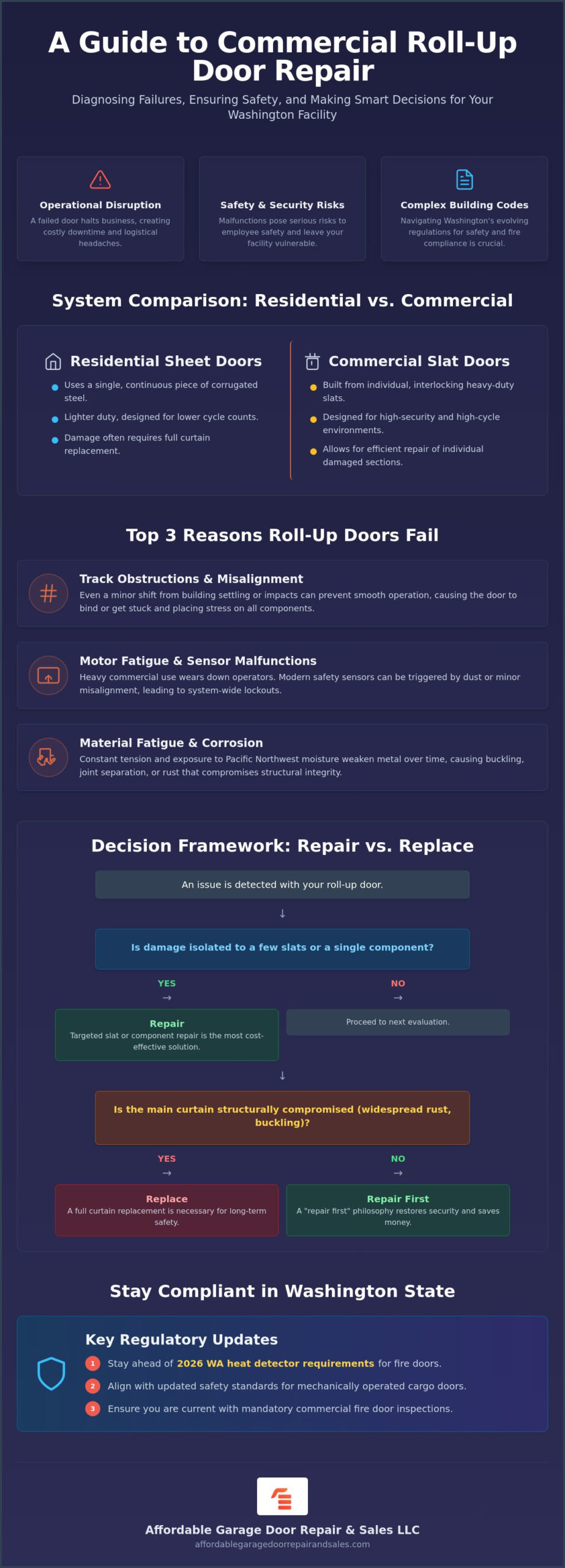
There’s a clear distinction between residential “sheet doors” and heavy-duty commercial “slat doors.” Sheet doors use a single, continuous piece of corrugated steel, while slat doors consist of individual interlocking pieces. Slat doors are the standard for high-security environments because they’re easier to maintain if a single section is dented. However, the “workhorse” nature of both types leads to specific fatigue in the curtain and barrel over time. By 2026, many of these systems have transitioned toward integrated smart sensors. While these sensors enhance safety, common calibration errors now account for a significant portion of service calls requiring professional roll-up garage door repair.
Anatomy of a Roll-Up Door System
The barrel and guide assembly serve as the core of the system. The barrel sits at the top of the opening, housing the tension springs that counterbalance the door’s weight. As the door opens, it follows the guide tracks, coiling tightly around the barrel. In the Pacific Northwest, high-quality weather stripping is essential. It prevents moisture from entering the tracks and causing premature rust, which is a common trigger for roll-up garage door repair in damp climates like Everett or Auburn. Most systems rely on either manual tension springs or motor-driven operators, both of which require precise alignment to function.
Top 3 Reasons Roll-Up Doors Fail
Mechanical systems eventually encounter friction or misalignment. Here are the primary issues we see across Washington:
- Track obstructions and misalignment: Building settling or minor impacts can nudge tracks out of alignment. Even a small shift prevents the door from coiling smoothly and can lead to the door becoming stuck.
- Motor fatigue and electrical sensor malfunctions: Automated operators face heavy cycles in commercial settings. The 2026 shift toward advanced safety sensors means that even a small amount of dust or a minor misalignment can trigger a system-wide lockout.
- Material fatigue in the slats or curtain sheets: Constant tension and environmental exposure eventually weaken the metal. In sheet doors, this shows up as buckling, while slat doors may experience separation at the joints, compromising the curtain’s structural integrity.
Garage Door Cable Replacement and Spring Tension for Roll-Up Systems
Lifting cables are the unsung heroes of any overhead system. While the motor provides the operational signal, the cables do the heavy work by transferring torque from the internal torsion barrel to the bottom of the door curtain. When these steel strands begin to fail, the entire system becomes a significant safety hazard. Professional roll-up garage door repair often centers on these components because they bear the full weight of the steel curtain during every opening and closing cycle.
Property owners should watch for specific warning signs of impending failure. A “jumping” sensation during operation often indicates that a cable is beginning to unspool or has lost its alignment on the drum. You might also notice visible fraying or a cable that appears slack when the door is closed. Ignoring these signs leads to the unspooling effect, where a snapped cable causes the door to crash down unevenly. This often results in permanent damage to the tracks or the internal barrel itself.
The Mechanics of Cable Failure
In the Pacific Northwest, constant exposure to moisture and road salt accelerates cable corrosion. Rust weakens the individual steel strands, causing them to snap under the high tension required for daily operation. A lifting cable is a high-strength steel wire designed specifically to support the weight of the door curtain as it travels through the guides. If you suspect your cables are compromised, a professional safety inspection can identify microscopic stress fractures before they lead to a total system failure.
Spring Tension and Balance Adjustments
Spring tension is the invisible force that makes a heavy steel door feel light enough for a motor to lift. If your door feels unusually heavy or slams shut with excessive force, the tension is likely out of balance. Balancing a roll-up curtain requires extreme precision to ensure the slats coil evenly around the barrel. Proper calibration doesn’t just improve safety; it significantly extends the life of your opener by reducing the mechanical load on the motor. Adhering to Federal safety standards ensures that your automated systems respond correctly to obstructions, protecting both people and property.
Attempting DIY repairs on high-tension springs or cables is exceptionally dangerous. These components store massive amounts of mechanical energy that can cause severe injury if released improperly. Professional technicians use specialized winding bars and tensioning tools to manage this energy safely. Relying on an expert ensures that your roll-up garage door repair meets local Washington safety codes while providing long-term reliability for your facility.
Roll-Up Door Repair vs. Replacement: A Decision Framework
Deciding between a targeted fix and a total system overhaul requires a clear look at both your immediate budget and the long-term reliability of your facility. A standard industry guideline is the “50% Rule.” If the estimate for a roll-up garage door repair approaches or exceeds half the price of a brand-new unit, investing in a replacement is usually the more stable choice. This logic accounts for the fact that while a repair addresses a specific failure, it doesn’t reset the clock on other aging parts like the internal barrel or the motor’s logic board. You’re often better off putting those funds toward a system that carries a fresh manufacturer warranty.
Structural integrity is the next factor to evaluate. For commercial slat doors, we can often replace a single dented slat without replacing the entire curtain. This modularity is a significant advantage for businesses in high-traffic areas where minor impacts occur. However, if the curtain is “crinkling” or the guides are severely warped, the door’s safety is compromised. Beyond mechanical health, 2026 energy efficiency standards in Washington now play a larger role in this decision. Modern systems offer superior thermal breaks and insulation that older models simply can’t match. Upgrading your door can greatly increase your home’s curb appeal and overall property value in competitive markets like Seattle and Spokane.
When to Opt for Professional Repair
Targeted repairs are ideal when the core structure of the door remains sound. If the curtain is in good condition but you’re dealing with broken cables, snapped springs, or worn rollers, these are routine component fixes. Professional technicians can often resolve minor track misalignments or recalibrate sensors without needing to tear out the entire system. Regular maintenance is the best way to avoid “off-track” emergencies that disrupt your daily operations. Choosing a repair-first approach for these issues keeps your costs low while maintaining the security of your property.
Signs You Need a Full Replacement
Total replacement becomes necessary when parts for older models are no longer available or when the damage is extensive. Significant collision damage that twists the tracks or compromises the barrel’s mounting points usually makes repair impossible. You might also consider a new garage door installation Washington if your current system lacks modern insulation. Newer doors utilize advanced materials that help regulate temperature, which is a major benefit during the damp winters and hot summers of the Pacific Northwest. If your door is over twenty years old, the gain in safety, efficiency, and smart-tech compatibility often outweighs the cost of repeated repairs.
Professional Repair Standards and Safety Compliance in Washington
Navigating regulatory standards is essential for maintaining both safety and insurance eligibility. In 2026, NFPA 80 compliance remains a critical benchmark for commercial roll-up fire doors across Washington. This standard mandates annual inspections to ensure that fire-rated curtains drop correctly in the event of an emergency. Professional technicians perform “drop tests” to verify that the door’s closing speed is controlled and that it resets properly. Failure to document these tests can lead to significant liability issues or the denial of commercial insurance claims. For property managers, scheduling a professional roll-up garage door repair or safety audit isn’t just a maintenance task; it’s a legal necessity that protects the facility’s occupants and the business’s bottom line.
Washington’s diverse geography dictates specific maintenance cycles that vary by city. In Seattle and Everett, the primary enemy is persistent moisture, which leads to rapid cable corrosion and roller degradation. Conversely, Spokane’s heavy snow and ice accumulation put immense strain on motors and can freeze tracks solid, causing the door to jump off its guides. These regional factors mean a one-size-fits-all maintenance plan doesn’t work. We recommend seasonal adjustments to your service schedule to account for these environmental stressors before they cause a total system lockout.
Local Code and Safety Requirements
Washington state building code updates for 2026 have introduced specific amendments that directly affect garage installations and repairs. For instance, WAC 51-51, Section R314.2.3, now requires heat detectors in all new garages attached to dwellings. Additionally, as of April 20, 2026, WAC 296-56-60127 outlines stricter safety requirements for mechanically operated cargo doors. This includes enhanced guarding for counterweights and ensuring that lifting tackle maintains a safety factor of five. All modern opener systems must also adhere to UL 325 standards, which mandate automatic reversal features and photoelectric sensors to prevent entrapment during operation.
Preventative Maintenance Checklist for WA Owners
Preventive maintenance is the best defense against unexpected downtime and costly roll-up garage door repair bills. A structured approach helps identify minor issues before they escalate into dangerous mechanical failures.
- Lubrication: Apply high-quality, non-silicone lubricants to rollers and tracks every six months, especially in high-moisture regions like the Puget Sound.
- Visual Inspection: Check cables, end bearings, and slats for microscopic cracks, fraying, or signs of material fatigue.
- Safety Testing: Conduct monthly tests of the auto-reverse feature to ensure the system responds to obstructions instantly.
If your system fails any part of this checklist or if you’ve noticed a change in operational noise, it’s time to book a professional safety inspection to restore full functionality and ensure your property meets all current local regulations.
Reliable Roll-Up Door Repair Services with Affordable Garage Door Repair
When a mechanical failure leaves your facility vulnerable, you need a partner that responds with precision and speed. Affordable Garage Door Repair & Sales LLC provides 24/7 emergency response for stuck roll-up doors in Everett, Seattle, and Spokane. We understand that operational downtime isn’t just an inconvenience; it’s a security risk and a financial burden for your business. Our team is trained to handle the specific complexities of roll-up garage door repair, ensuring that your system is restored to full functionality without unnecessary delays. By maintaining regional offices in Everett, Spokane, and Yakima, we act as a community anchor that’s always within reach when you face a hardware crisis.
The “Repair First” philosophy is central to our operations. Rather than pushing for a total system replacement at the first sign of trouble, our technicians focus on component-level fixes that save you money. Whether it’s replacing a frayed cable, swapping out a high-tension spring, or realigning a single slat, we prioritize the longevity of your existing door. This approach relies on our deep technical competence and our commitment to providing value to Washington residents. We offer free on-site estimates and transparent 2026 pricing, so you’ll always know the scope of the work before we begin. Our expertise spans both residential sheet doors and heavy-duty industrial slat systems, making us a versatile expert for any property type.
Why Washington Trusts Our Technicians
Local expertise is what sets our service apart from national corporations. We understand the specific environmental needs of communities in Puyallup, Tacoma, and Yakima, where temperature swings and moisture levels can wreak havoc on metal components. Our service trucks are fully stocked with high-quality parts, which allows us to complete most repairs in a single visit. This efficiency minimizes the time your property is left exposed. We don’t just fix the immediate problem; we focus on safety and long-term durability to ensure the repair stands up to the rigors of daily use in the Pacific Northwest.
Schedule Your Professional Inspection Today
Recognizing the difference between an emergency and a maintenance call can help you manage your facility more effectively. An emergency usually involves a door that’s stuck in the open position, a snapped lifting cable, or a total motor failure that blocks your primary exit. Scheduled maintenance is better suited for addressing noisy operation, slow response times, or minor track misalignments. Our process for cable and spring replacement is methodical, prioritizing the safe management of stored mechanical energy. If you’re ready to secure your property, contact our regional WA offices to schedule a professional inspection and ensure your system meets all 2026 safety standards.
Securing Your Washington Property for the Future
Maintaining a reliable overhead system requires a balance of technical awareness and proactive care. Understanding the mechanical stress on lifting cables and staying current with 2026 safety regulations prevents unexpected downtime. A component-level approach to roll-up garage door repair often provides a more cost-effective solution than a full system replacement. Minor hardware fatigue shouldn’t be allowed to compromise your facility’s security or your compliance with local building codes. Safety remains the highest priority.
Affordable Garage Door Repair & Sales LLC is ready to help you navigate these technical challenges. We provide 24/7 emergency service across Washington, with expert technicians specializing in precision cable and spring repair. Whether your facility is in Everett, Spokane, or Yakima, we offer the local expertise needed to keep your doors moving safely. Get a Free On-Site Estimate for Your Roll-Up Door Repair today to ensure your system remains a durable asset for years to come. Investing in professional maintenance now creates a stable foundation for your daily operations.
Frequently Asked Questions
How much does it cost to replace a roll-up garage door cable?
Cable replacement costs depend on the door’s size and the specific weight of the curtain. While industry averages for Washington provide a general range, the final price is determined by the gauge of the steel cable and the labor required to reset the tension barrel safely. Most professionals recommend replacing both cables simultaneously to ensure even lifting and prevent future imbalance issues.
Can I repair a dented roll-up door slat myself?
Repairing a dented slat yourself isn’t recommended due to the structural tension held by the curtain. In slat-style commercial doors, individual interlocking pieces can be replaced, but this requires sliding the curtain out of the guides. Residential sheet doors often require a more comprehensive fix if the metal is buckled. Attempting this without specialized tools can lead to the door becoming stuck or falling.
How often should a commercial roll-up door be inspected for safety?
Commercial doors must undergo a professional safety inspection at least once per year to remain compliant with NFPA 80 standards. For high-traffic facilities or those in harsh environments like Spokane or Seattle, bi-annual checks are often better. These inspections verify the integrity of the springs and the function of the auto-reverse sensors, ensuring the system meets all 2026 Washington building code requirements.
What should I do if my roll-up door is stuck halfway?
You should immediately stop using the opener and avoid forcing the door manually if it becomes stuck. A door jammed halfway often indicates a snapped cable or a significant track obstruction. Forcing the curtain can warp the slats or damage the internal barrel assembly. It’s best to call for an emergency roll-up garage door repair to secure the opening safely and prevent further mechanical damage.
Are roll-up garage doors more difficult to repair than sectional doors?
Roll-up doors present unique challenges because their primary components are housed within a compact overhead barrel. While sectional doors have visible tracks and springs along the ceiling, roll-up systems require specialized knowledge of internal torsion barrels and interlocking slats. This compact design makes them ideal for space-constrained properties but necessitates professional expertise for most mechanical failures or adjustments.
Why is my roll-up door making a loud grinding noise?
Loud grinding typically signals metal-on-metal friction within the guide tracks or the barrel assembly. This often occurs when the door is out of alignment or when the end bearings are failing. In the damp climate of the Pacific Northwest, rust accumulation on the slats can also cause significant noise. Regular lubrication and a professional roll-up garage door repair assessment can resolve these sounds before they lead to a total breakdown.
Does a roll-up door require a special type of opener?
Yes, roll-up doors typically utilize a jackshaft opener or a specialized commercial motor mounted to the side of the barrel. Unlike standard residential openers that use a central rail and trolley, these motors drive the shaft directly to rotate the curtain. Selecting the correct motor depends on the door’s weight and the number of daily cycles it’s expected to handle for your specific application.
Can I automate an existing manual roll-up door?
You can automate most manual roll-up doors by installing a side-mount motor and a compatible drive sprocket. This upgrade improves facility efficiency and enhances safety by adding modern sensor technology. Before automation, a technician must verify that the door is perfectly balanced and that the tracks are in good condition to handle the consistent force of a motorized operator.