The sleekest garage door on the market could be a functional nightmare if it doesn’t align with your specific spatial constraints or local climate needs. When weighing sectional vs roll up garage doors, many homeowners assume the choice is purely aesthetic, yet the mechanical reality determines everything from your overhead storage capacity to your monthly heating bill. You likely want a system that enhances your home’s curb appeal while standing up to Washington’s persistent moisture and strict energy codes.
It’s understandable to feel overwhelmed by technical specifications and maintenance requirements. This 2026 comparison guide clarifies the trade-offs between these two popular systems, focusing on space efficiency, long-term durability, and cost. You’ll discover which door offers the superior insulation needed for Pacific Northwest winters and how to select a mechanism that maximizes your available square footage. From modern smart features to 2021 IRC compliance, we provide the practical insights required to choose a door that delivers both performance and peace of mind.
Key Takeaways
- Identify how track-based sectional systems and drum-based roll-up designs impact your overhead storage and ceiling clearance.
- Discover why sectional doors are the preferred choice for meeting Washington’s specific R-value and energy efficiency requirements.
- Assess the long-term maintenance needs and lifespan differences of sectional vs roll up garage doors to plan for future repairs.
- Learn the critical criteria for deciding between high-traffic commercial durability and residential aesthetic customization.
Sectional vs. Roll Up Garage Doors: Understanding the Mechanisms
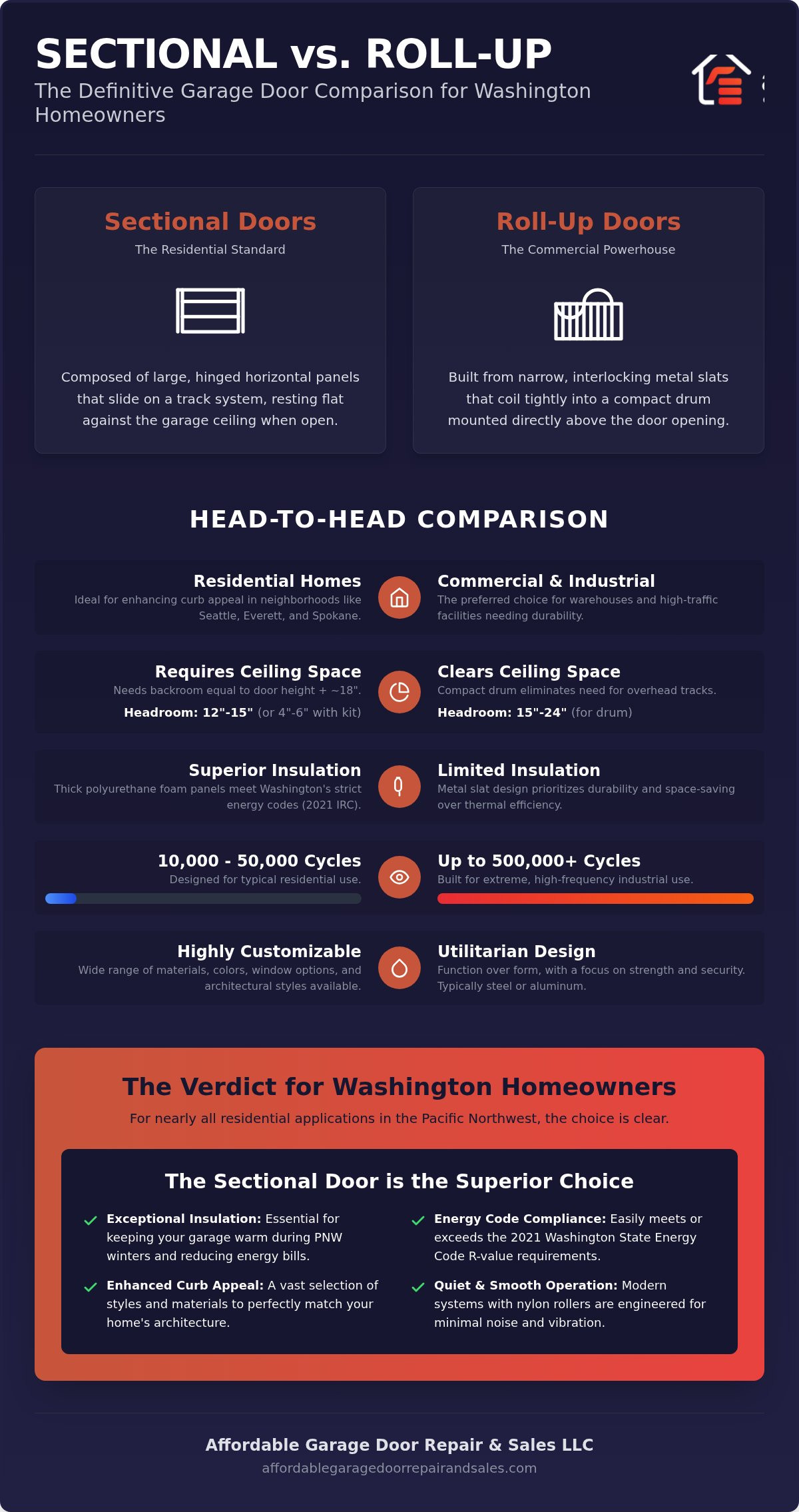
Selecting the right entry system for your property requires a clear understanding of mechanical engineering. When comparing sectional vs roll up garage doors, the primary difference lies in how the door stores itself when open. Sectional doors use a series of large, horizontal panels joined by hinges. These panels travel along a track system to rest flat against the garage ceiling. Roll-up doors consist of narrow interlocking metal slats that coil into a compact drum mounted directly above the door opening.
In Washington cities like Seattle, Everett, and Spokane, sectional doors are the standard for residential homes. They allow for high-performance insulation and a wide variety of architectural styles that complement local neighborhoods. Conversely, roll-up doors are the preferred choice for commercial and industrial sites. Their design is ideal for warehouses or storage facilities where ceiling space must remain clear for lighting, HVAC systems, or fire sprinklers. A detailed review of Garage door types and materials reveals that these two systems serve distinct functional needs based on their structural layout.
How a Sectional Garage Door Operates
A sectional door relies on a curved track system that guides the panels from a vertical position to a horizontal plane. This movement is balanced by either torsion springs, mounted on the wall above the door, or extension springs located along the horizontal tracks. These springs do the heavy lifting, ensuring the door remains easy to operate manually or with an electric opener. Modern residential models are engineered for quiet operation, utilizing nylon rollers and dampened hinges to reduce vibration. Because the panels are large and solid, they provide an excellent foundation for the thick polyurethane insulation required by the 2021 Washington State Energy Code.
The Mechanics of a Roll Up Garage Door
The mechanics of the roll-up design prioritize space efficiency and high-frequency durability. Instead of sliding back into the garage, the door’s slats wrap tightly around a barrel assembly. This coiling action eliminates the need for overhead tracks, which is a significant advantage in buildings with high ceilings or limited backroom. These systems are built to endure rigorous environments. While a standard residential sectional door is typically rated for 10,000 to 50,000 open-and-close cycles, commercial rolling steel doors are often rated for 25,000 to over 500,000 cycles. This extreme resilience makes them the logical choice for busy Washington industrial hubs where the door may open dozens of times each day. The debate of sectional vs roll up garage doors often centers on this trade-off between residential comfort and industrial strength.
Space Requirements: Headroom, Backroom, and Side Clearance
The physical footprint of your door system is just as critical as its appearance. When comparing sectional vs roll up garage doors, you must evaluate three primary measurements: headroom, backroom, and side clearance. Headroom is the vertical distance between the top of the door opening and the ceiling. Backroom refers to the depth the system extends into the garage, while side clearance is the space on either side of the opening needed for tracks and springs. A low-headroom kit is a specialized track modification that allows a sectional door to operate in residential garages with as little as 4 to 6 inches of ceiling clearance.
Most standard sectional installations require 12 to 15 inches of headroom to accommodate the curve of the tracks and the torsion spring assembly. Roll-up doors often require more vertical headroom, typically 15 to 24 inches, to house the coiling drum. However, they win on backroom efficiency. Our team can help you evaluate your garage’s unique dimensions to ensure your chosen system operates without interference.
Why Sectional Doors Need Ceiling Space
Sectional doors rely on a track system that must extend deep into the garage. As the door opens, the panels slide back and rest parallel to the ceiling. This means the backroom must equal the height of the door plus roughly 18 inches for the motor and rail. This configuration can interfere with overhead storage racks, high-mounted shelving, or hanging light fixtures. To reclaim some of this space, many homeowners now opt for wall-mounted “jackshaft” openers. These smart upgrades mount to the side of the door rather than the ceiling, clearing up the central “trolley” area. Regardless of the opener type, all installations must adhere to Federal safety standards for garage doors to ensure the auto-reverse mechanisms function correctly within these tracks.
The Compact Advantage of Roll Up Doors
Roll-up doors offer a “zero backroom” benefit that is difficult to match. Because the entire door curtain coils into a single header unit above the opening, the rest of the garage ceiling remains entirely unobstructed. This makes them the ideal solution for properties with very high ceilings, slanted roofs, or internal obstructions like fire sprinklers and HVAC ducts. By containing all moving parts within the drum and vertical side guides, roll-up models maximize every square inch of usable floor and wall space. If you’re looking to enhance your storage in these areas, you can visit Affordable Cabinets & Closets for custom garage cabinets. While they lack the aesthetic variety of sectional panels, their ability to disappear into a compact roll makes them a favorite for utility-focused spaces and commercial bays across Washington.
Durability, Maintenance, and Common Repairs
The longevity of your entry system depends heavily on its intended usage frequency. In the debate of sectional vs roll up garage doors, durability is often measured in duty cycles. A standard residential sectional door is typically rated for 10,000 to 50,000 cycles. In contrast, heavy-duty rolling steel doors are built to handle 25,000 to over 500,000 cycles. This massive difference explains why warehouses and high-traffic shipping bays require commercial garage door repair services that specialize in these high-cycle components. While sectional doors are resilient enough for a typical family’s daily routine, they aren’t designed for the constant motion of an industrial environment.
Operational stability is our priority at Affordable Garage Door Repair & Sales LLC. We provide 24/7 emergency services for both residential and industrial clients to address sudden mechanical failures across Washington. Whether it’s a snapped cable on a sectional door or a jammed drum on a roll-up system, we ensure your property remains secure and functional. Regular safety inspections can prevent most of these issues before they lead to an expensive emergency call-out.
Spring Systems and Wear Patterns
Springs are the most stressed components in any garage system. For homeowners, broken garage door spring repair is a common maintenance event because sectional doors rely on exposed torsion or extension springs. These springs lose tension or snap after several years of service. Roll-up doors often utilize an internal spring mechanism housed within the barrel or drum. This enclosed design protects the spring from dust and moisture, which is particularly beneficial in Washington’s damp climate. Regardless of the door type, you shouldn’t attempt to adjust or replace springs yourself. The high tension involved poses a severe safety risk that requires professional tools and training.
Long-Term Maintenance Costs
Maintaining a sectional door involves a more complex checklist than a roll-up model. You must regularly inspect and lubricate numerous moving parts, including hinges, rollers, and the tracks themselves. If a vehicle collision occurs, sectional doors offer a cost advantage because you can often replace a single damaged panel rather than the entire door. A Sectional vs. Rolling Garage Door Comparison shows that while roll-up doors have fewer exposed parts to lubricate, damage to the curtain often requires more extensive repairs or a full curtain replacement. This trade-off between fewer maintenance tasks and potentially higher repair costs for major damage is a key factor for property managers to consider.
Insulation, Security, and Curb Appeal
The choice between sectional vs roll up garage doors often comes down to how you intend to use your garage space. Sectional doors are the gold standard for homeowners with attached garages because they function as a primary thermal barrier between the outdoors and your living space. These doors allow for thick layers of polyurethane insulation, which can achieve R-values as high as R-18. This level of thermal resistance is difficult to achieve with roll-up doors. Because roll-up systems consist of many narrow interlocking slats, the numerous joints between those slats allow for more air infiltration than a solid sectional panel.
Security is a vital consideration for any property owner. Heavy-duty steel roll-up curtains provide an exceptional level of physical protection against forced entry, which is why they dominate the commercial and industrial markets. However, modern residential sectional doors are also highly secure. They incorporate reinforced tracks and sophisticated locking mechanisms that integrate directly with home security systems. For a typical neighborhood setting, the security of a well-installed sectional system is more than sufficient to protect your vehicles and belongings.
Thermal Efficiency in Washington’s Climate
Washington’s diverse climate requires a door that can handle damp winters in Seattle and freezing temperatures in Spokane. Sectional doors feature comprehensive weather stripping along the bottom, sides, and top. This perimeter seal prevents cold drafts and moisture from creeping into the garage. Roll-up doors are inherently less efficient in these environments. The coiling design makes it difficult to maintain a continuous thermal break. For homeowners looking to reduce energy bills or maintain a climate-controlled workshop, the sectional design is the logical recommendation.
Maximizing Curb Appeal with Sectional Designs
Aesthetic flexibility is where sectional models truly shine. You can choose from a vast array of finishes, including realistic faux wood, matte black, or charcoal. Modern designs often include carriage-house styles or full-view glass panels that let in natural light. For detailed inspiration on current trends and materials, consult our guide on new garage door installation Washington. Roll-up doors are generally limited to a utilitarian, industrial look. While this is perfect for a warehouse or a detached storage unit, it rarely matches the architectural character of a modern Pacific Northwest home. If you’re ready to upgrade your property’s protection and appearance, request a professional consultation today to explore our full range of insulated and secure door options.
Choosing the Best Door for Your Washington Property
The decision between sectional vs roll up garage doors rests on your property’s structural needs and your long-term goals for the space. If you’re a homeowner in Everett or Tacoma, a sectional door is almost always the superior choice for an attached garage. It provides the necessary insulation to keep your home energy-efficient and offers the curb appeal that maintains your property value. While sectional models are the residential standard, some modern “industrial-style” homes are experimenting with roll-up doors to achieve a warehouse-loft aesthetic, though this often requires a trade-off in thermal performance.
For commercial property managers, the roll-up door is a strategic investment in operational uptime. Its ability to withstand high-frequency usage without the maintenance overhead of multiple hinges and rollers makes it indispensable for Washington’s industrial hubs. Whether you’re managing a fleet in Seattle or a storage facility in Spokane, the space-saving drum mechanism ensures your ceiling remains clear for vital equipment like HVAC ducts or fire sprinklers.
Residential vs. Commercial Applications
A quick-reference checklist can help narrow your focus during the selection process:
- Choose Sectional if: You have an attached garage, require high R-value insulation, or want custom window and color options to match your home’s architecture.
- Choose Roll-Up if: You manage a high-traffic commercial bay, have limited backroom for overhead tracks, or require a fire-rated door system.
Commercial property managers benefit from the extreme durability of roll-up models, which are engineered to handle hundreds of thousands of cycles. This resilience is a primary factor in reducing long-term repair costs in high-traffic environments where a standard residential door would fail prematurely.
Professional Installation and Free Estimates
Attempting a DIY installation for either door type carries significant risks. Garage doors are the largest moving objects in most buildings; a slight miscalculation in spring tension or track alignment can lead to property damage or serious injury. Professional installers ensure that every component meets the 2021 Washington State Building Code, including specific wind load and heat detector requirements. This technical precision is what guarantees the longevity of your investment.
Affordable Garage Door Repair & Sales LLC serves a wide geographic range, providing expert support from Yakima and Pasco to the greater Seattle area. We recommend starting with a professional on-site estimate to accurately measure your headroom and side-room clearances. This step eliminates the guesswork and ensures your new door fits perfectly the first time. Contact Affordable Garage Door Repair today to schedule your expert consultation and secure a durable, high-performance entry system for your Washington property.
Secure Your Property with the Right Door System
Affordable Garage Door Repair & Sales LLC is your dependable local partner for expert installation and 24/7 emergency service. We handle all major brands and provide the technical precision needed to ensure your system operates smoothly for years. Schedule Your Free On-Site Estimate with Affordable Garage Door Repair today to verify your garage’s dimensions and receive a professional recommendation tailored to your needs. We’re ready to help you secure a reliable and efficient entry system for your home or business.
Frequently Asked Questions
Which is more expensive: a sectional or a roll-up garage door?
Sectional doors are generally more affordable for residential installations. Determining the total value of sectional vs roll up garage doors requires looking at both the initial purchase and the long-term maintenance costs. Roll-up models involve more complex engineering and heavy-duty steel, leading to higher upfront costs. However, their extreme durability often results in a lower cost per cycle over a 20 year lifespan.
Can I install a roll-up door on my residential garage?
You can install a roll-up door on a residential property, though it’s less common than sectional models. Homeowners usually choose them for detached shops or when they want to save ceiling space. Note that they typically offer less insulation and a more industrial look compared to sectional doors. This choice is often driven by utility rather than neighborhood aesthetics.
Which door type is better for a garage with very low headroom?
Sectional doors equipped with low-headroom kits are the best choice for tight vertical clearances. While roll-up doors save backroom, they require significant headroom, often 15 to 24 inches, for the drum assembly. A low-headroom sectional track can operate with as little as 4 to 6 inches of space above the opening. This makes the sectional design more versatile for older Washington homes with low ceilings.
Are sectional garage doors more secure than roll-up doors?
Roll-up doors are generally considered more secure due to their heavy-duty steel construction and lack of leverage points. The interlocking slats of a roll-up curtain are difficult to pry open. Sectional doors are still highly secure for residential use, but the rolling steel design is the standard for high-security commercial applications. Both systems can be integrated with modern smart security upgrades for peace of mind.
Do roll-up garage doors require more maintenance?
Roll-up garage doors actually require less frequent maintenance because they have fewer exposed moving parts. Sectional doors have numerous hinges, rollers, and tracks that need regular lubrication and inspection to prevent noise and wear. Roll-up systems enclose most components within the drum, though the internal spring still requires professional check-ups. This makes the roll-up system a more hands-off option for busy property owners.
Can I get an insulated roll-up garage door for my shop?
You can get insulated roll-up garage doors, but they generally offer lower R-values than sectional models. Because the slats must be thin enough to coil, the insulation layer is limited. If thermal efficiency is your top priority for a Washington workshop, a high-R-value sectional door remains the superior choice. Sectional panels can accommodate much thicker polyurethane insulation to meet strict energy codes.
How much backroom do I need for a sectional garage door installation?
You typically need backroom equal to the door’s height plus an additional 18 inches. This space allows the tracks and the opener’s rail to extend fully into the garage. When comparing sectional vs roll up garage doors, remember that roll-up models require virtually zero backroom since they coil at the header. This makes roll-ups ideal for garages with overhead obstructions like HVAC ducts or storage racks.
What happens if a single panel on my sectional door gets dented?
You can usually replace a single damaged panel on a sectional door without replacing the entire system. This modular design makes repairs more cost-effective after minor accidents or vehicle collisions. With a roll-up door, damage to the curtain often requires a more extensive and expensive replacement of the entire slatted section. This ability to perform localized repairs is a major benefit for residential homeowners.