It’s 7:15 AM, you’re already behind schedule for a morning commute in Seattle, and your garage door opener remote is not working despite your repeated attempts. You press the button again, but the heavy door remains stubbornly shut, leaving your car trapped and your schedule in disarray. It’s a stressful situation that quickly leads to concerns about home security and the fear of a costly repair bill for a system that was working perfectly just yesterday. While a stuck door is a headache, keeping your vehicle in peak condition is just as important for a reliable commute; for professional vehicle maintenance and breakdown support, you can visit Garage Automobile VLB to see how expert technicians ensure automotive reliability. We recognize that a silent garage door feels like a major mechanical failure, but the issue is often rooted in signal interference or a simple safety lockout rather than a broken motor. This 2026 troubleshooting guide provides the clarity you need to diagnose the problem quickly and safely. You’ll learn how to use the Wall Button Test to isolate the fault and understand how the cold Spokane climate might be affecting your remote’s battery life. We outline the exact steps to resync your device and explain when a professional opener replacement is the most reliable path forward. Our goal is to provide a logical, steady solution that restores your home’s accessibility and your peace of mind.
Key Takeaways
- Learn how the Wall Button Test serves as the primary diagnostic tool to isolate whether your handheld remote or the opener motor is at fault.
- Understand why the “Lock” feature on your wall console might be the hidden reason for an unresponsive device and how to quickly disable it.
- Identify how external signal interference from household electronics or specific light bulbs can lead to your garage door opener remote not working.
- Distinguish between a simple signal failure and a safety sensor misalignment that causes the door to reverse unexpectedly during operation.
- Recognize the specific signs that indicate a DIY fix is no longer viable and a professional safety inspection or opener replacement is required.
Initial Triage: Is it the Remote or the Garage Door Opener?
When you discover your garage door opener remote not working, the first step is to determine if the failure lies in the handheld device or the motor unit itself. This process, known as triage, prevents unnecessary expenses and identifies whether you need a simple battery or a professional opener replacement. By isolating the components, you can narrow down the cause from dozens of possibilities to a single, manageable fix.
The Wall Button Diagnostic
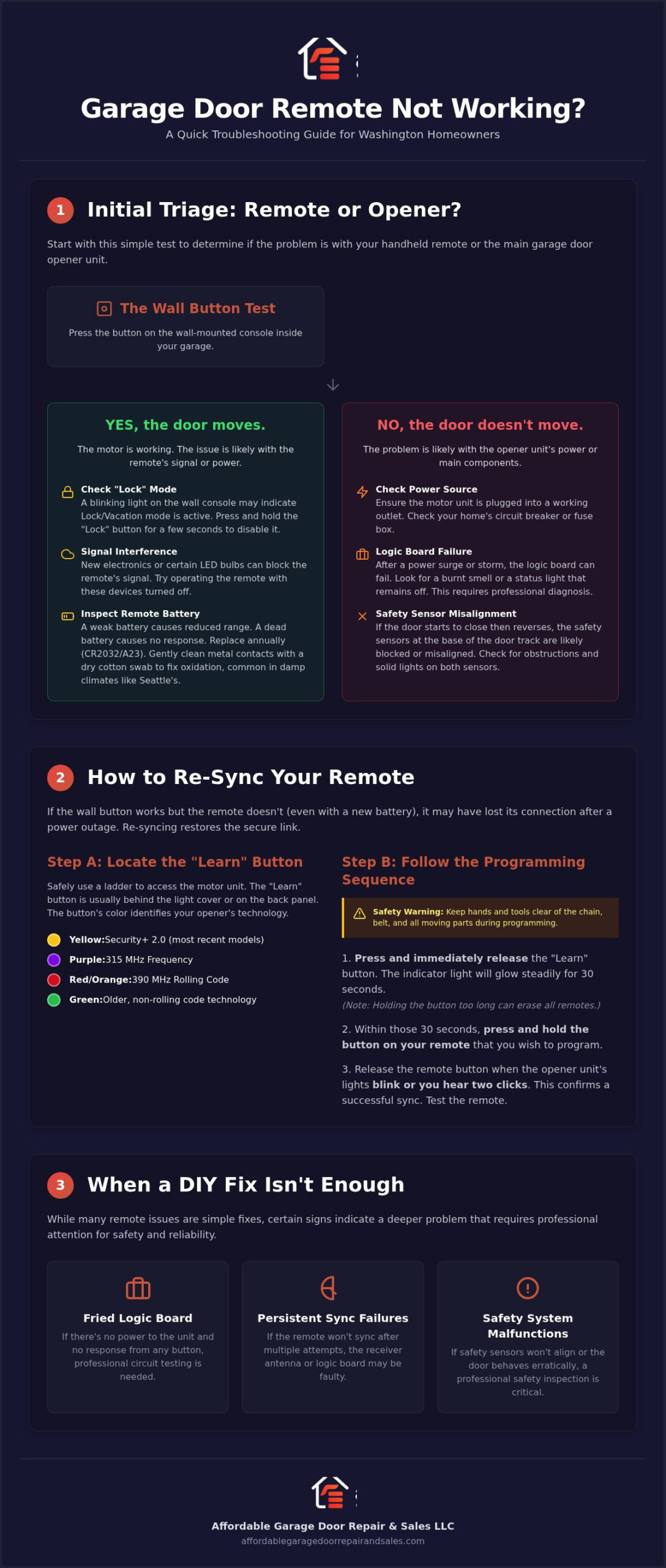
The Wall Button Test is the most reliable way to isolate the source of the problem. Walk over to the hardwired console inside your garage and attempt to open the door. If the door moves, you know the motor has power and the mechanical components are functional. However, if the wall button light is blinking, the system is likely in Lock or Vacation mode. This security feature is often accidentally engaged during cleaning or by children. It intentionally disables all radio signals to prevent unauthorized entry. This is why your remote appears unresponsive while the physical button still works. Simply hold the Lock button for several seconds to restore signal reception.
Battery and Contact Inspection
In Washington’s damp climate, specifically in areas like Everett and Seattle, moisture can lead to subtle terminal oxidation inside the remote casing. Even if you don’t see visible corrosion, a thin layer of film can block the low voltage required for signal transmission. This is a common culprit when a garage door opener remote not working after a particularly humid season.
- Battery Types: Most modern remotes use CR2032 lithium coins or A23 alkaline batteries. It’s best to replace these annually.
- Range Issues: If you have to be right next to the door for it to work, the battery is likely weak. A complete lack of response usually indicates a dead cell or a broken contact.
- Cleaning Terminals: Use a dry cotton swab to gently buff the metal contacts. This often restores the connection without needing a new device.
If neither the wall button nor the remote produces a sound or light from the motor, you may be facing a logic board failure. This is a common issue after a Pacific Northwest lightning storm or a local power surge. While a desynced remote can be reprogrammed in minutes, a fried logic board usually requires a professional technician to evaluate the internal circuitry. Look for signs like a burnt smell near the motor or a status light that remains dark despite being plugged into a working outlet.
How to Re-Sync and Program Your Garage Door Remote
If you find your garage door opener remote not working after a winter storm in Spokane or a sudden power outage in Everett, the device has likely lost its connection to the motor unit. This memory loss occurs because the internal logic board often resets during voltage fluctuations. While the motor remains functional, the security handshake between the remote and the receiver is broken. Re-establishing this link is a standard maintenance task that restores your access without requiring new hardware.
Locating the Learn Button
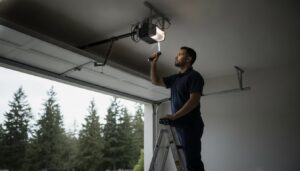
To begin, you must access the motor head. Safely position a ladder to the side of the unit rather than directly underneath the door’s path. Most modern systems, including those from LiftMaster and Chamberlain, house the “Learn” button behind the light lens cover or on the rear panel. The color of this button is a critical diagnostic detail because it indicates the radio frequency and security technology used by your system. Identifying the color helps you ensure your remote is compatible with the motor’s receiver.
- Yellow: Indicates Security+ 2.0 technology, found in the most recent models.
- Purple: Signifies the system operates on the 315 MHz frequency.
- Red or Orange: Indicates an older 390 MHz rolling code system.
- Green: Found on older units that may use non-rolling code technology.
Step-by-Step Programming Guide
Once you’ve identified the button, the programming sequence is a straightforward action. Safety Warning: Always keep your hands and tools away from the chain, belt, or trolley while the unit is in programming mode. Unexpected movement can occur if the system triggers during the sync process. If your garage door opener remote not working after several attempts, ensure you’re not holding the Learn button too long; a long press often erases every remote programmed to the system, forcing you to start over with every device in your household.
- Press and immediately release the Learn button on the motor unit.
- Within 30 seconds, press and hold the button on your handheld remote.
- Release the remote button when the motor unit light flashes or you hear two distinct clicks.
- Test the remote from outside the garage to confirm the range is sufficient.
If you’re syncing integrated vehicle buttons, such as HomeLink, the process is similar but may require a second person to press the car’s button while you remain at the motor. Older systems from the early 1990s that use manual dip switches lack modern rolling code security and are increasingly difficult to sync with universal remotes. If your system refuses to hold a program despite these steps, it might be time for a professional opener replacement to ensure your home remains secure and accessible.
Signal Interference: Why Your Remote Range Has Dropped
Sometimes the issue isn’t a dead battery or a broken motor; it’s an invisible barrier. If you find your garage door opener remote not working only when the door is closed, or if the range has suddenly plummeted from the end of the driveway to just three feet away, you’re likely dealing with signal interference. This occurs when other electronic devices “crowd” the radio frequency your remote uses to communicate with the motor unit.
The LED Light Bulb Problem
LED bulbs are energy efficient, but they can be a significant headache for garage openers. Many non-shielded LED and CFL bulbs emit electromagnetic interference during operation. This electronic noise “jams” the 315MHz or 390MHz frequency your remote relies on. To verify if this is the cause, simply unscrew the bulbs from the opener unit and test the remote again. If the range immediately returns to normal, you should switch to “Garage Door Rated” LED bulbs. These specific bulbs are designed with extra shielding to prevent radio frequency noise from interfering with your signal.
Antenna and Physical Obstructions
Check the small purple or gray wire hanging from the motor unit. This is your antenna. For optimal reception, it should be hanging straight down or angled slightly toward the garage door. If it’s tucked inside the motor housing or bent upward, your range will suffer. Furthermore, physical obstructions often play a role. Modern homes in Washington often use foil-backed “radiant barrier” insulation or metal siding. These materials can act as a Faraday cage, blocking signals from reaching the receiver. In these cases, installing an external antenna kit can bypass the metal barrier and restore reliable functionality.
Residents in Washington often face unique interference challenges due to geography and infrastructure. Proximity to military bases, such as Joint Base Lewis-McChord or Naval Air Station Whidbey Island, can occasionally cause atmospheric radio frequency interference that affects older garage door systems. Additionally, high-density housing in cities like Seattle or Bellevue means more neighbors with competing wireless devices. Use the “Driveway Test” to confirm the source: if the remote works perfectly when the garage door is already open but fails when it’s closed, the door material or internal interference is the primary culprit. If it fails regardless of the door’s position, the problem is likely the remote hardware or external RF noise.
When the Issue Isn’t the Remote: Mechanical and Safety Failures
If your handheld transmitter has fresh batteries and a clear line of sight but you still find your garage door opener remote not working, the problem likely stems from the system’s safety logic. Modern openers are built to prioritize safety over convenience. They’ll intentionally ignore remote commands if they detect a mechanical obstruction or a safety sensor fault. This is a protective feature. It’s not a malfunction of the remote itself. Don’t force it. Attempting to bypass these safety protocols by repeatedly pressing the button can lead to motor burnout or structural damage to the door panels.
Safety Sensor Misalignment
Safety sensors, or photo-eyes, sit near the floor on both sides of the garage door track. These units must maintain a perfect line of sight to allow the door to close. Check the lights. One should be solid green and the other solid amber. If these lights are flickering or dark, the remote will fail to initiate the closing cycle. In Washington, we often see these sensors compromised by common garage debris. Cobwebs, thick dust, or even low-angle sunlight during a clear Spokane afternoon can “blind” the lens. Cleaning the lenses with a soft, dry cloth and tightening the mounting brackets usually restores consistent remote operation.
Broken Springs and Motor Strain
Sometimes the motor receives the signal but simply cannot perform the work. If you hear a strained humming sound or see the motor carriage move an inch before stopping, a snapped torsion spring is the likely culprit. This is frequently mistaken for a signal failure because the door stays on the ground. You shouldn’t attempt to adjust or replace these springs yourself. The tension required to lift a heavy door is stored entirely in these components. They are dangerous. For residents in Everett, Tacoma, or Spokane facing these high-risk mechanical issues, seeking emergency garage door repair is the safest course of action.
When DIY troubleshooting confirms that your garage door opener remote not working is actually a symptom of a deeper mechanical failure, professional intervention is necessary. We offer expert broken garage door spring repair and comprehensive safety inspections to get your system back in peak condition. Contact Affordable Garage Door Repair & Sales for a reliable resolution that prioritizes your home’s security and your family’s safety.
Professional Solutions for Washington Homeowners
If you’ve followed every step in this guide and still find your garage door opener remote not working, the issue likely involves internal circuitry or advanced signal conflicts that require specialized diagnostic tools. While DIY fixes are excellent for basic maintenance, persistent failures often signal that the motor unit has reached the end of its functional lifespan. Professional intervention ensures that you don’t spend hours on a temporary repair when a more stable, long-term solution is necessary for your home’s security. Our technicians bring a methodical approach to every service call, identifying the root cause of the failure with precision.
Smart Opener Upgrades
Modern technology has moved beyond the traditional handheld transmitter. If your current system is outdated or frequently desyncs, a professional garage door opener replacement guide can help you navigate the transition to smart technology. These systems allow you to control your door via smartphone apps, eliminating the “dead battery” problem entirely. You’ll benefit from real-time alerts and rolling code technology that generates a new security code every time the door is used, making it virtually impossible for hackers to duplicate your signal. This upgrade provides a level of resilience and safety that older, analog systems simply cannot match.
Why Choose Affordable Garage Door Repair & Sales?
We serve as a reliable local partner for residents across Washington, providing comprehensive support from Seattle and Everett to Tacoma and Spokane. Our team is also proactive in Puyallup, Auburn, and Yakima, ensuring that professional help is never far away. We understand that a door that won’t close is a security risk, which is why we maintain 24/7 availability for emergency repairs. Our highly trained professionals provide free on-site estimates, giving you a clear, organized path to a resolution without the stress of hidden costs. We take pride in our identity as a community anchor that values functional results over flashy promises.
A certified safety inspection offers the peace of mind that a simple battery change cannot provide. We check every component, from the tension in the torsion springs to the integrity of the logic board, ensuring your entire system operates with precision and durability. Whether you’re dealing with a minor residential fix or a large-scale project, our versatile experts are ready to assist. Contact us today for fast, reliable garage door repair!
Restore Your Garage Access and Security
A garage door opener remote not working is a frustrating disruption, but it doesn’t always signal a total system failure. By performing the Wall Button Test and checking for external signal interference from LED bulbs or local radio frequencies, you can often resolve the issue yourself. However, if the problem lies in a snapped torsion spring or a malfunctioning logic board, prioritizing professional safety is the most dependable choice. These complex mechanical systems require precision to ensure long-term durability and household safety.
Affordable Garage Door Repair & Sales is your proactive partner for all garage door needs across Washington. We provide 24/7 emergency service to residents in Everett, Spokane, and Seattle, ensuring you’re never trapped by a mechanical failure. Our expert technicians are ready to provide free on-site estimates to identify the most efficient and cost-effective path forward for your home. Don’t let a faulty remote compromise your peace of mind. Get a Free Estimate for Garage Door Repair today and return to a routine that’s both secure and convenient.
Frequently Asked Questions
Why does my garage door remote only work when I’m right in front of the door?
Low battery power is the primary reason for reduced range. As voltage drops, the signal strength weakens significantly. In cold regions like Spokane, CR2032 batteries can drain faster than in warmer climates. You should also check for physical obstructions or a poorly positioned antenna wire. A damaged or tucked-away antenna can severely limit the reception range of your handheld transmitter.
Can a power outage cause my garage door remote to stop working?
Yes, power surges often erase the memory of the opener’s internal logic board. When power returns to your home, the remote and motor unit may no longer recognize each other’s security codes. You’ll need to follow the standard resyncing steps to restore the connection. If the unit remains completely unresponsive after power is restored, the logic board might have suffered permanent electrical damage during the outage.
How do I know if my garage door opener logic board is bad?
Look for a total lack of response from both the remote and the wall button as a primary indicator. If the unit is plugged in but the status lights are off or the motor makes no sound, the board is likely fried. Other signs include erratic behavior, such as the door opening unexpectedly. We recommend a professional safety inspection to confirm a board failure and discuss repair options.
Will a universal remote work with any garage door opener?
Universal remotes work with major brands like LiftMaster and Chamberlain, but they aren’t compatible with every system. Success depends on the manufacturing year and the specific radio frequency used. Older systems from the early 1990s without rolling code technology often require legacy transmitters. Always verify your motor’s Learn button color before purchasing a replacement to ensure the technologies can communicate effectively.
Why is the light on my garage door opener flashing when I try to use the remote?
Flashing lights typically indicate a safety sensor obstruction or an active lockout mode. If the door doesn’t move and the light blinks, the photo-eyes are likely misaligned or blocked by debris. It can also mean the Vacation lock on your wall console is engaged. This is a frequent cause for a garage door opener remote not working when the motor itself is still receiving power.
What should I do if my garage door keypad isn’t working either?
Start by replacing the 9V battery inside the keypad housing. These units are exposed to Washington’s rain and humidity, which often leads to corroded battery contacts. If a new battery doesn’t resolve the issue, the keypad may need to be reprogrammed to the motor unit. If both the keypad and the remote fail simultaneously, the problem is likely found within the opener’s internal receiver.
Is it safe to replace garage door remote batteries myself?
Yes, replacing batteries is a safe and straightforward maintenance task for any homeowner. Most remotes utilize a small coin cell or a 12V alkaline battery. You’ll typically need a small flathead screwdriver to gently pop the casing open. Just ensure you don’t touch the internal circuit board with metal tools, as this could cause a short and permanently damage the handheld device.
How often should I replace my garage door remote?
A high-quality remote can last a decade, but the internal buttons eventually wear out from repeated use. If you find your garage door opener remote not working despite fresh batteries and clean contacts, the physical switch inside has likely reached its limit. Upgrading to a newer model also provides better security through modern rolling code technology, which prevents signal duplication by unauthorized parties.