According to the International Code Council, nearly 30% of businesses require modifications or extra inspections because of overlooked compliance issues with their facility doors. For a busy warehouse or distribution center in Washington, these technical oversights often turn into expensive operational delays or safety liabilities. You rely on your equipment to work without question, and a malfunctioning door is a variable your budget shouldn’t have to account for.
We understand that managing a facility involves balancing workplace safety with daily efficiency. This guide provides a clear, expert framework for commercial garage door maintenance designed to help you avoid emergency repair costs and meet all OSHA and UL 325 standards. We’ll outline how to extend the lifespan of your hardware, ensure full compliance with regional codes like Seattle’s Director’s Rule 21-86, and secure your warehouse envelope against modern vulnerabilities. By following a proactive schedule, you can turn a potential mechanical headache into a predictable, manageable part of your facility’s success.
Key Takeaways
- Understand how a proactive service schedule protects your bottom line by reducing total ownership costs and preventing logistical delays.
- Follow our essential checklist for commercial garage door maintenance to master balance testing and visual hardware inspections.
- Discover how to integrate smart monitoring and high-security interlocks to protect your warehouse from unauthorized access during after-hours.
- Learn to adapt your maintenance routine for Washington’s diverse climate, from coastal moisture in Tacoma to the temperature extremes of Spokane.
- Identify which complex repairs require a professional technician to ensure safety and when to utilize emergency support for collision damage.
The ROI of Preventative Commercial Garage Door Maintenance
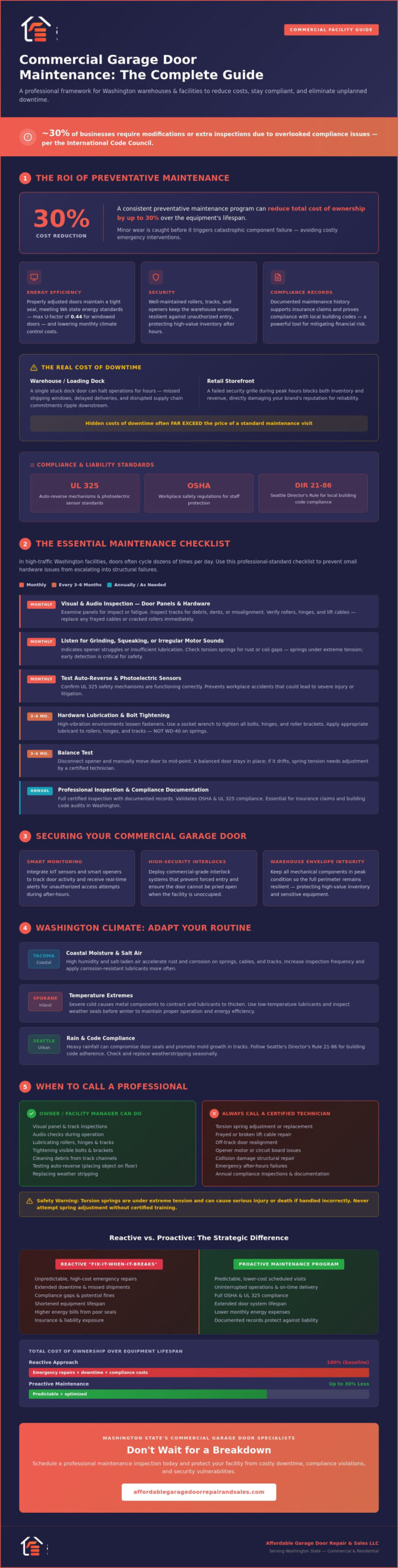
Viewing maintenance as a simple recurring cost is a common strategic mistake. In reality, a proactive approach is a high-yield investment in your facility’s infrastructure. Industry data suggests that a consistent program for commercial garage door maintenance can reduce the total cost of ownership by up to 30% over the equipment’s lifespan. These savings are achieved by identifying minor wear before it triggers a catastrophic component failure, which would require expensive emergency intervention. Beyond the mechanical hardware, a properly adjusted garage door improves energy efficiency by maintaining a tight seal. This helps Washington businesses meet state-specific energy standards, such as the maximum U-factor of 0.44 for doors with windows, while lowering monthly climate control expenses.
A well-maintained door also serves as the first line of defense for your facility’s security. When rollers, tracks, and openers are kept in peak condition, the entire warehouse envelope remains resilient against unauthorized entry. This stability provides peace of mind for business owners who need to protect high-value inventory and sensitive equipment after hours. By prioritizing regular checks, you transition from a reactive “fix-it-when-it-breaks” mindset to a controlled, predictable operational strategy.
Preventing Operational Downtime
When a door fails, the impact ripples through your entire organization. A single stuck door at a critical loading dock can halt warehouse operations for hours, leading to missed shipping windows and delayed outgoing deliveries. This creates a “butterfly effect” where one mechanical glitch disrupts established supply chain commitments and frustrates downstream partners. For a retail storefront, a failed security grille during peak business hours doesn’t just block inventory; it blocks revenue and damages your brand’s reputation for reliability. These hidden costs of downtime often far exceed the price of a standard maintenance visit.
Compliance and Liability Protection
Safety standards like UL 325 and OSHA regulations are legal requirements designed to protect your staff and your business. Proper maintenance ensures that auto-reverse mechanisms and photoelectric sensors function correctly, preventing workplace accidents that could lead to severe injury or litigation. In Washington, keeping documented maintenance records is essential for insurance claims and proving compliance with local building codes. If an incident occurs, a clear history of professional inspections demonstrates that you’ve met your duty of care as a property manager. This documentation is a powerful tool for mitigating financial risk and ensuring a safe, compliant work environment.
The Essential Commercial Garage Door Maintenance Checklist
A reliable framework for commercial garage door maintenance begins with a methodical inspection of every mechanical component. In high-traffic Washington facilities, doors often cycle dozens of times per day, creating constant vibration and wear. This checklist isn’t merely a suggestion; it’s a professional standard designed to ensure that small hardware issues don’t escalate into structural failures. By following these steps, you maintain the “warehouse envelope” and protect both your inventory and your personnel.
Start with the structural elements. Examine the door panels for signs of impact or fatigue that could compromise the door’s integrity. Check the tracks for any debris, dents, or misalignment that might cause the rollers to bind. Finally, verify the condition of the hardware, including the rollers, hinges, and lift cables. If you notice any frayed cables or cracked rollers, these components require immediate attention to prevent a total system shutdown. When repeated repairs on aging hardware begin to add up, it may be worth evaluating the commercial garage door repair vs replacement decision to determine the most cost-effective path forward.
Monthly Visual and Audio Inspections
Your ears are often the first tools to detect a problem. Listen for grinding, squeaking, or irregular motor sounds during operation. These noises typically indicate that the opener is struggling or that moving parts lack sufficient lubrication. Pay close attention to the torsion springs; look for signs of rust or gaps in the coils. Since these springs are under extreme tension, identifying a potential break before it happens is critical for workplace safety. Regular audio checks help you spot alignment issues in the tracks before they lead to an expensive off-track door scenario.
Hardware Lubrication and Tightening
High-vibration environments naturally loosen fasteners over time. Every three to six months, use a socket wrench to tighten all bolts, hinges, and roller brackets. It’s vital to inspect the “back hang” and ceiling supports, as these hold the weight of the door in the open position. When it comes to lubrication, use industry-standard silicone or lithium-based sprays on all moving parts, including the springs and rollers. Never use WD-40 on your tracks. While it’s a common household cleaner, it actually attracts dust and grime in a commercial setting, creating a sticky residue that eventually jams the system. A quick professional safety inspection can confirm that your lubrication and hardware tension meet manufacturer specifications.
Balance and Safety Calibration
A heavy-duty sectional or rolling steel door must remain perfectly balanced to function safely. To test this, disconnect the opener and lift the door halfway by hand. A well-balanced door will stay in place; if it slams shut or pulls upward, the spring tension is incorrect and needs adjustment. Additionally, you must calibrate the safety eyes and force settings on your commercial openers. These sensors must be aligned and clean to comply with UL 325 standards, ensuring the door reverses immediately if an obstruction is detected. This calibration is a fundamental step in maintaining a compliant and secure facility.
How to Secure Your Commercial Garage Door Against Intrusions
Security is a critical pillar of facility management that goes beyond simple mechanical reliability. While previous sections focused on the functional aspects of commercial garage door maintenance, ensuring the security of your warehouse envelope is equally vital for protecting your assets. A door that operates smoothly but fails to secure your inventory is a significant liability. Modern security strategies involve a combination of physical reinforcements and digital safeguards to create a multi-layered defense against unauthorized entry.
Implementing rolling code technology and encrypted remotes is a fundamental step in preventing signal hacking. These systems change the access code every time the remote is used, making it nearly impossible for intruders to intercept and duplicate the signal. For high-risk areas, upgrading to reinforced panels or impact-resistant glass provides an additional layer of defense against forced entry. Integrating your openers with smart monitoring systems allows for real-time alerts, so you know exactly when a door is accessed after hours.
Physical Security Reinforcements
Physical barriers remain the most direct way to deter intruders. Manual locking bars and high-security slide locks should be inspected regularly as part of your commercial garage door maintenance routine to ensure they aren’t bent or rusted. Maintaining the integrity of the door tracks is also essential; loose or damaged tracks can be pried or lifted, creating an easy entry point. Additionally, high-quality bottom seals and astragals serve a dual purpose. They improve energy efficiency and prevent “fishing” attacks, where an intruder uses a hook to reach the emergency release cord from the outside.
Digital and Opener Security
Digital security has become just as important as physical locks in the modern industrial environment. Upgrading to smart commercial openers with “Automatic Door Lock” features ensures the door is physically locked into the track every time it closes. For facilities with multiple employees, setting up user-specific access codes for commercial keypads allows you to track who enters the building and when. This level of accountability is a powerful deterrent against internal and external security breaches. Finally, performing routine firmware updates for your openers is a simple but overlooked task. These updates often include security patches that close vulnerabilities discovered by manufacturers, keeping your digital perimeter as secure as your physical one.
Washington Climate Factors: Maintenance for Every Region
Washington’s diverse geography demands a localized approach to equipment care. A maintenance strategy that works for a warehouse in the mild, damp climate of Western Washington will likely fall short for a facility facing the thermal extremes of the Inland Empire. Addressing these regional environmental stressors is a core component of effective commercial garage door maintenance. By adapting your care routine to your specific zip code, you ensure the long-term resilience of your facility’s entry points and avoid unexpected mechanical failures.
Regional factors like high-velocity winds in the Columbia River Gorge or salt air along the Pacific coast require specialized attention. These elements don’t just affect the door panels; they impact the springs, rollers, and electronic components that keep your operations moving. Understanding the specific threats in your area allows you to prioritize the right tasks during your scheduled inspections.
Moisture Management and Rust Prevention
For businesses operating near Puget Sound, Seattle, or Tacoma, moisture is a constant threat to mechanical integrity. High humidity and consistent rainfall lead to rapid oxidation of unprotected metal surfaces. Utilizing galvanized hardware is a critical preventative measure; it provides a protective zinc coating that resists the oxidation common in damp environments. We recommend applying specialized protective coatings to springs and cables, as these high-tension components are particularly vulnerable to corrosive pitting. Additionally, maintaining high-quality weather stripping is vital. It doesn’t just keep the interior dry; it prevents water from pooling in the tracks and causing hidden rust at the door’s base. Coastal businesses must also contend with salt air, which necessitates more frequent rinsing and lubrication of all exposed hardware to neutralize salt deposits.
Winterization for Eastern Washington
Facilities in Spokane, Yakima, and across the Columbia Basin face a different set of challenges. Extreme temperature drops during the winter months can significantly affect the viscosity of standard lubricants, causing them to thicken and become tacky. This puts unnecessary strain on the motor and can lead to an opener failure. Switching to a low-temperature, synthetic lubricant ensures smooth operation even when the mercury dips below zero. You should also regularly check for ice buildup within the door tracks and at the threshold. If a door freezes to the floor, attempting to open it can snap the cables or burn out the motor. Finally, inspecting the insulation and R-value of your door panels is a critical part of winter commercial garage door maintenance. Proper insulation maintains facility climate control and reduces the energy load on your heating systems during the coldest months. If you are unsure if your current system is prepared for the next freeze, scheduling a professional safety inspection can provide the necessary peace of mind.
When to Call Affordable Garage Door Repair & Sales LLC
Distinguishing between basic care and professional intervention is vital for maintaining a safe and efficient workplace. While facility staff can perform the visual checks and basic lubrication outlined earlier, complex mechanical adjustments require specialized tools and technical training. Attempting to manage heavy-duty industrial components without the proper expertise often leads to increased repair costs or workplace injuries. Affordable Garage Door Repair & Sales LLC provides the dependable support needed to keep your facility running smoothly. We offer free on-site estimates for commercial upgrades and planned maintenance programs, giving you a clear path toward long-term operational stability.
Our team specializes in high-cycle torsion springs and heavy-duty sectional door installation. We understand that commercial doors are significant assets that require precision handling to maintain their safety ratings. Whether you are dealing with a door that is not opening or you need a full system upgrade to meet new energy codes, our solution-oriented approach focuses on durability and value. We treat every project as a partnership, ensuring that your specific functional needs are met with high-standard service. If your aging system has reached the point where ongoing repairs are no longer cost-effective, our team can walk you through the commercial garage door repair vs replacement analysis to help you make the most financially sound decision for your facility.
Professional Safety Inspections
Our comprehensive 25-point safety inspection covers every critical failure point in a commercial system that might be missed during a standard walkthrough. We verify the structural integrity of the tracks, the tension of the springs, and the calibration of all safety sensors to ensure compliance with UL 325 standards. It’s important to understand the danger of attempting torsion spring replacement without professional tools. These components are under immense tension; a single mistake can lead to catastrophic hardware failure or severe injury. We also handle commercial cable repair and panel replacement with precision, ensuring the door remains perfectly balanced and secure against the elements.
Custom Maintenance Programs for WA Businesses
Every facility has unique operational demands that dictate how often service is required. We tailor our commercial garage door maintenance schedules based on your facility’s specific cycle count and regional environmental factors. A high-volume distribution center in Tacoma might require quarterly visits, while a smaller storage facility in Wenatchee may only need semi-annual service. Our priority service agreements provide local warehouses with peace of mind, knowing they have a reliable partner ready to respond. If your facility experiences collision damage or an off-track door, our 24/7 emergency response team is available to restore your security and minimize downtime. Schedule a professional commercial safety inspection today to protect your facility’s bottom line.
Securing the Future of Your Facility
Managing a commercial facility requires attention to detail and a commitment to long-term reliability. We’ve explored how proactive care reduces total ownership costs and why adapting to Washington’s unique climate is essential for hardware longevity. By combining regular physical inspections with modern digital security, you create a warehouse environment that’s both efficient and safe. Implementing a consistent program for commercial garage door maintenance ensures that your operations remain uninterrupted by mechanical failure. This strategic approach transforms your doors from potential liabilities into dependable assets.
Affordable Garage Door Repair & Sales LLC serves as your proactive local partner throughout Washington State. With specialized expertise in sectional and roll-up doors, we provide the technical support needed to maintain high-cycle equipment from Seattle to Spokane. Whether you require a routine safety check or need our 24/7 emergency commercial service for an urgent repair, we’re ready to assist. Take the guesswork out of your facility’s safety and performance. Contact us to Get a Free On-Site Estimate for Commercial Maintenance today. We look forward to helping you build a more resilient and secure business environment.
Frequently Asked Questions
How often should a commercial garage door be serviced?
Can I perform commercial garage door maintenance myself?
Facility managers can handle basic tasks like visual inspections, clearing debris from tracks, and surface lubrication. However, complex repairs involving high-tension springs, cable replacement, or motor calibration should always be left to a professional. Attempting to adjust heavy-duty hardware without specialized tools can lead to serious injury and may void your equipment warranty.
What are the signs that my commercial garage door springs are failing?
Visible gaps in the coils, heavy rust, or a door that feels sluggish during operation are primary indicators of spring fatigue. If the door struggles to lift or closes much faster than usual, the spring tension is likely compromised. Since these components have a finite cycle life, replacing them before they snap is a critical safety measure for any warehouse.
How much does a commercial garage door maintenance plan cost in Washington?
The cost of a maintenance plan depends on the number of doors at your facility and the frequency of the scheduled visits. Factors such as the specific door type and the complexity of the opener systems also influence the final estimate. We provide tailored quotes that account for your unique operational needs rather than offering a one-size-fits-all price.
Is a noisy garage door always a sign of a major problem?
Noise isn’t always a sign of a total system failure, but it shouldn’t be ignored. Squeaking or rattling usually indicates that parts need lubrication or that fasteners have loosened due to vibration. Persistent grinding or metal-on-metal sounds are more serious, as they often signal that the rollers are worn out or the tracks are misaligned.
What should I do if my commercial door is hit by a forklift?
Stop using the door immediately and secure the area to prevent staff from attempting to operate it. Even if the damage looks minor, the impact can knock the door off-track or bend the internal reinforcement struts. Operating a damaged door can cause the entire system to collapse, so a professional safety inspection is required before returning it to service.
How do I improve the security of my warehouse garage door?
Upgrading to smart openers with automatic deadbolt features and encrypted rolling code technology significantly reduces the risk of intrusion. You should also ensure that manual slide locks are functional for after-hours protection. Regularly inspecting the bottom seals and tracks helps prevent prying or “fishing” attempts by unauthorized individuals.
Are there specific OSHA requirements for commercial garage door maintenance?
OSHA requires that all power-operated doors are kept in a safe operating condition through regular inspections. This includes verifying that all safety sensors and auto-reverse mechanisms function correctly to prevent workplace entrapment. Keeping documented records of your commercial garage door maintenance helps demonstrate compliance during a safety audit.