Your stalling garage door isn’t failing; it’s likely saving you from a catastrophic repair bill. While it’s incredibly inconvenient when your garage door opens a little then stops, this behavior often indicates that a safety feature has successfully intervened to prevent further damage. We know how stressful it is to have your car trapped inside while worrying about the potential for unexpected repair costs or safety hazards. These concerns are valid, but understanding the underlying mechanics can quickly lower your stress levels.
Discover why your garage door is stalling halfway and learn how to identify the real culprit before a minor glitch becomes a major repair. This article examines five common myths surrounding door malfunctions and provides clear, professional solutions for each scenario. You’ll gain the clarity needed to decide if a fix is a simple DIY task or a job for a specialist, ensuring your door is safe to operate and your morning routine returns to normal quickly.
Key Takeaways
- Identify the difference between a safety stop and a safety reverse to understand if your door’s behavior is a standard precaution or a mechanical failure.
- Learn why it is a dangerous myth to increase opener force when a garage door opens a little then stops, especially when a snapped torsion spring is the real culprit.
- Discover how “invisible” obstructions, such as sensor misalignment caused by track vibrations, can halt your door’s movement even when the path looks clear.
- Master safe troubleshooting steps, including the manual lift test, to determine if your system requires a simple cleaning or professional mechanical repair.
- Ensure long term reliability and safety by choosing professional diagnostics over the “parts-cannon” approach to repairs.
Decoding the Stall: Why Your Garage Door Stops After a Few Inches
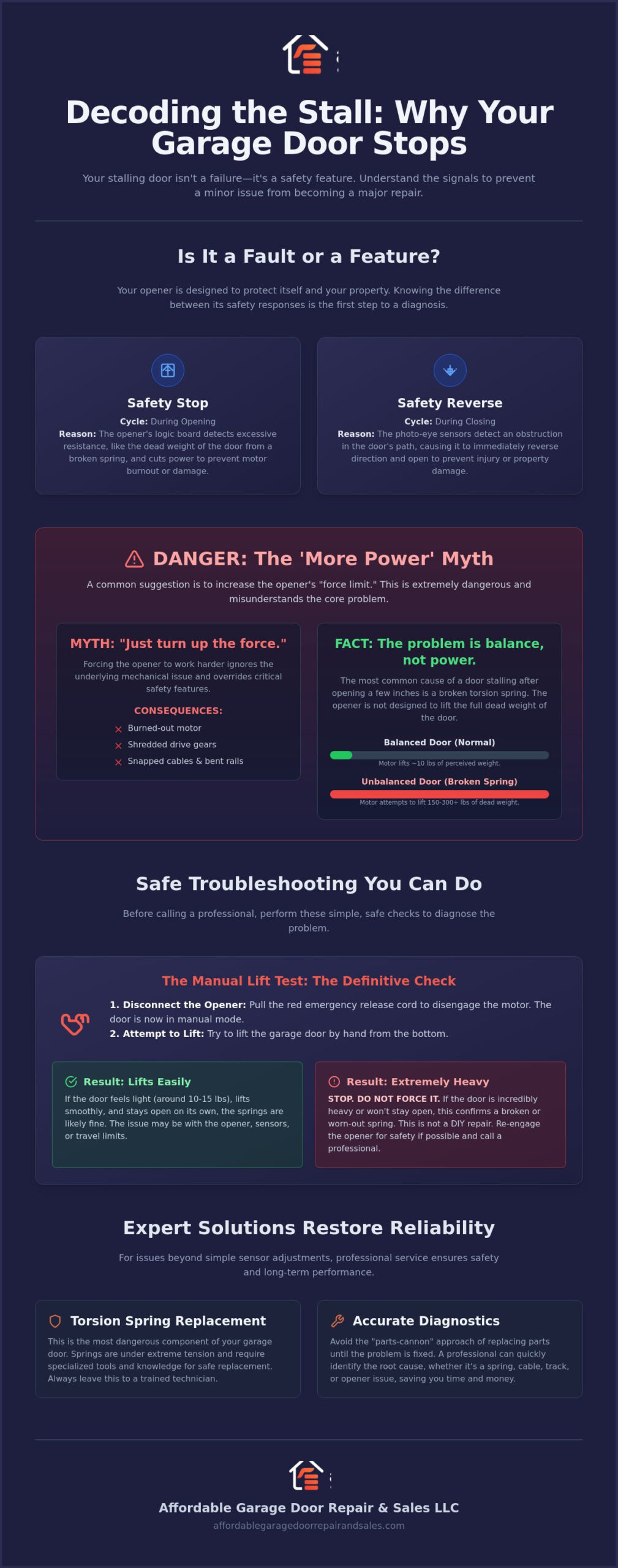
A garage door that begins to lift and then abruptly quits is frustrating, but it’s actually demonstrating garage door opener safety features in action. When your garage door opens a little then stops, it is usually the result of a safety mechanism rather than a total mechanical failure of the motor itself. Understanding the difference between a “Safety Stop” and a “Safety Reverse” is the first step in diagnosing the problem. A safety reverse typically occurs during the closing cycle when the photo-eye sensors detect an obstruction, causing the door to immediately head back up. In contrast, a safety stop happens during the opening cycle. The logic board detects an internal struggle, such as excessive weight or a physical bind, and cuts power to prevent the motor from burning out.
Homeowners often feel a sense of dread when the garage door opens a little then stops, assuming the motor is dying. In reality, the motor is likely in excellent condition. It is simply doing its job by refusing to overcome resistance that could cause further damage. Think of the motor as a circuit breaker; it trips to protect the system. The “Force Limit” settings on your opener are designed as a protection threshold, not a power dial. Cranking these limits higher to “force” the door open is a dangerous mistake that can lead to snapped cables or a bent top rail. If the door isn’t moving freely, the motor isn’t the culprit; the physical hardware is.
The 12-Inch Rule: Why it stops where it does
The first 6 to 12 inches of travel are the most demanding part of the entire cycle. This is the point where the door must transition from a dead stop into motion, moving from the vertical track into the radius of the curve. If your torsion spring is broken or has lost its tension, the opener is suddenly tasked with lifting 150 to 300 pounds of dead weight without any mechanical assistance. Most modern openers measure travel distance and resistance in real-time. If the resistance spikes immediately after the initial lift, the system identifies a failure and halts movement to ensure the door doesn’t fall or cause injury.
Visual Diagnostics: What to look for in the first 30 seconds
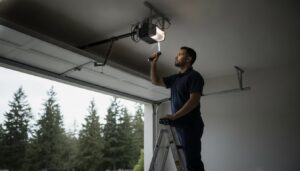
Before calling for service, a quick visual inspection can provide valuable clues. Start by looking at the opener unit itself. Many models use the main light bulb or a small LED on the side to flash diagnostic error codes. Count the flashes, as these patterns correspond to specific issues like sensor misalignment or travel limits. Next, observe the trolley and carriage assembly. Look for signs of binding or metal shavings that suggest the door is rubbing against the rail. Finally, inspect the vertical tracks. Even a small pebble or a slightly bent track flange can create enough friction to trigger a safety stop during those critical first few inches of travel.
The Torsion Spring Trap: Busting the ‘More Power’ Myth
A common but dangerous piece of advice circulating in online forums suggests that if your door is struggling, you should simply turn up the “Force” or “Travel” screws on the back of the opener. This is a fundamental misunderstanding of how the system works. When your garage door opens a little then stops, the opener isn’t lacking power; it is reacting to a massive mechanical imbalance. Modern openers must adhere to federal safety standards that require them to stop when they encounter unexpected resistance. Overriding these settings to force a heavy door upward is a recipe for catastrophic equipment failure.
The most frequent cause of this specific stall is a snapped torsion spring. Torsion springs store immense mechanical energy under extreme tension, making them the single most dangerous component for an untrained individual to adjust or replace. When a spring breaks, your opener is suddenly forced to lift 100% of the door’s weight, which can range from 150 to over 300 pounds. Most residential motors are not designed for this load. They will lift the door a few inches, detect the dead weight, and trigger an immediate safety stall to prevent the motor from burning out or the drive gears from shredding.
How Torsion Springs Actually Work
Torsion springs act as a counterbalance rather than a direct lifting mechanism. They “weight” the door so that it feels like it only weighs about 10 pounds to the motor or a person lifting it manually. Over time, the steel in these springs undergoes metal fatigue. In Washington regions like Spokane and Yakima, the extreme cold of winter causes the metal to become brittle. This is why springs often snap during the first cold snap of the season. A fatigued spring might still lift the door partially, but a completely snapped one will leave the door feeling like an anchor.
The Danger of Overriding Safety Limits
Attempting to bypass the safety stall by increasing the force limit puts extreme stress on the opener’s internal components. Most openers use plastic or nylon drive gears that will strip under excessive load, turning a simple spring fix into a full opener replacement. If you suspect a mechanical issue, performing a “Balance Test” is the safest diagnostic step. Close the door, pull the emergency release cord, and try to lift the door halfway by hand. If it feels impossibly heavy or won’t stay open at the midpoint, you require professional broken garage door spring repair to restore the system’s balance. For homeowners dealing with a heavy or unbalanced door, contacting a specialist at Affordable Garage Door Repair & Sales LLC ensures the repair is handled with the correct tools and safety protocols.
Sensors, Cables, and Tracks: The ‘Invisible’ Obstructions
A common misconception among homeowners is that photo-eye sensors only matter when a door is closing. While it’s true that the federal safety standard for automatic residential garage door operators focuses primarily on preventing entrapment during the downward cycle, these sensors can still interrupt the opening process. If your garage door opens a little then stops, you might be experiencing the “Jerk Effect.” This occurs when the initial torque of the motor creates a vibration that travels through the tracks and brackets. If a sensor bracket is slightly loose, this vibration can knock the infrared eyes out of alignment for just a fraction of a second, causing the logic board to halt operation as a safety precaution.
Beyond the sensors, the physical environment in the Pacific Northwest plays a significant role in door reliability. In cities like Seattle and Everett, rapid temperature swings and high humidity levels cause metal components to expand and contract. This thermal movement can shift track alignment by small but critical margins. If the vertical tracks aren’t perfectly plumb, the rollers may bind against the metal as the door attempts to transition into the radius of the curve. The opener interprets this friction as a physical obstruction and stops the motor to prevent the cables from snapping or the motor from overheating.
Photo-Eye Sensitivity and Vibration
Vibrations are often the hidden culprit behind a stalling door. If your door starts to lift but quits as soon as the motor reaches full speed, inspect the stability of your sensor brackets. You can test this theory using a simple “Bypass” method: press and hold the wall button firmly. If the door opens completely while you hold the button but stalls when using a remote, you’ve confirmed a sensor or wiring fault. Additionally, check for sun-glare interference. At certain times of the day, direct sunlight can “blind” the receiving eye, making the system think the path is blocked.
Cables and Drums: The Hidden Tensioners
Cables are responsible for transferring the spring’s energy to the bottom of the door. If a cable becomes frayed or develops “bird-nesting,” where the steel strands unravel and bunch up, it won’t wrap cleanly around the cable drum. This causes the door to lift unevenly. A tilted door creates immense friction within the tracks, which almost always triggers a safety stall. This “cable creep” is often mistaken for a failing motor, but it is actually a warning sign of an impending off-track emergency. Regularly inspecting your cables for frayed wires or signs of slipping can prevent a minor glitch from becoming a major mechanical failure.
Safe Troubleshooting: What Washington Homeowners Can Do (and Can’t)
When your garage door opens a little then stops, you can perform several safe diagnostic steps to determine if the issue is a simple maintenance task or a professional repair. Taking a methodical approach helps you avoid unnecessary service fees while ensuring your family’s safety. Start by checking the diagnostic LED on the opener motor head. Manufacturers like LiftMaster and Chamberlain use specific blink patterns to communicate errors. A rapidly flashing light often points to a sensor obstruction, while a specific count of blinks might indicate a travel limit error or a mechanical bind.
Follow these five steps to triage the situation:
- Perform a manual lift: Pull the emergency release cord only when the door is fully closed to check the balance.
- Clean the sensors: Use a soft, dry cloth to wipe the photo-eye lenses and ensure they are aligned using a standard level.
- Clear the tracks: Inspect the vertical and horizontal tracks for small pebbles, dried grease, or debris that could cause a “safety stop.”
- Check the LED: Note any flashing patterns on the opener unit to cross-reference with the owner’s manual.
- Apply lubrication: Use a high-quality silicone-based spray on rollers and hinges; never use WD-40, as it attracts dust and worsens friction over time.
The Manual Lift Test
Safely pulling the red emergency release cord is the most revealing diagnostic tool available to a homeowner. It’s vital to only pull this cord when the door is in the down position to prevent it from crashing if a spring is broken. Once the opener is disconnected, try to lift the door by hand. If the door feels exceptionally heavy or won’t stay open at the halfway point, your torsion springs have likely failed. If the door moves smoothly and stays balanced, the problem lies within the opener settings or the sensor alignment. If these steps don’t resolve the stall, contact Affordable Garage Door Repair & Sales LLC for a professional diagnostic.
Washington Climate Maintenance Tips
The variable temperatures and high humidity in Seattle and Everett create unique challenges for garage door hardware. During humid winters, tracks can become “sticky” as moisture mixes with old grease, creating a thick sludge that triggers safety sensors. To prevent morning stalls, we recommend homeowners schedule a garage door safety inspection at least once a year. Regular maintenance ensures that hardware is tightened and lubricated with products designed to withstand Washington’s specific temperature ranges, keeping your system dependable regardless of the season.
Expert Solutions: Restoring Reliability to Your Garage Door
When your garage door opens a little then stops, the temptation to guess which part is failing can lead to “parts-cannon” repairs. This approach involves buying and replacing sensors, rollers, and logic boards one by one, hoping to hit the right solution. Professional diagnostics eliminate this guesswork and save you money by identifying the exact mechanical or electronic failure during the first visit. At Affordable Garage Door Repair & Sales LLC, we provide a stable, solution-oriented approach that prioritizes long-term functionality over temporary fixes. Our technicians are trained to look beyond the surface to find the root cause of the stall.
We understand the urgency of a car trapped in the garage or a home that isn’t secure. We offer emergency 24/7 garage door repair to ensure that a mechanical glitch doesn’t derail your entire day or compromise your safety. Whether the issue is a snapped cable, an off-track door, or a failing logic board, our team arrives prepared to handle the repair immediately. This responsiveness is a cornerstone of our role as a reliable local partner for Washington homeowners.
Comprehensive Repairs in Everett, Seattle, and Beyond
Our service area spans across the state, from the humid coastal environments of Everett and Seattle to the variable climates of Spokane and Yakima. Our approach to same-day service focuses on total system verification. We don’t just fix the obvious symptom; we inspect the springs, cables, and opener settings to ensure the entire system is operating at peak efficiency. This methodical process prevents the “jerk effect” and other vibration-related issues from recurring. We provide free on-site estimates, giving you a clear and professional assessment of the necessary work before any repairs begin.
Upgrading for Long-Term Peace of Mind
Sometimes a persistent stall indicates that an aging opener is reaching the end of its reliable lifespan. Modern openers manufactured after the UL 325 standards are significantly more sensitive and reliable than older models. Transitioning to a modern, smart opener system offers advantages that go beyond simple operation. Openers equipped with battery backups ensure your door remains functional during Washington’s frequent storm-related power outages. Smart upgrades also provide real-time alerts to your smartphone if the door fails to open or close fully, allowing you to monitor your home’s security from anywhere. If your current system is outdated or frequently unreliable, you can explore our guide on New Garage Door Installation in Washington for high-efficiency models that offer the latest in safety and durability.
Restore Your Garage Door’s Performance and Safety
A stalling door is often a sign that your system’s safety protocols are working exactly as intended to prevent mechanical damage. By distinguishing between simple sensor misalignments and serious torsion spring failures, you can address the root cause without the risk of unnecessary part replacements. Basic cleaning and lubrication are effective maintenance tasks, but heavy mechanical components require the precision of a specialist to ensure long-term durability. When your garage door opens a little then stops, prioritizing professional diagnostics protects both your equipment and your household’s safety.
Affordable Garage Door Repair & Sales LLC is your dependable partner for comprehensive solutions across Washington, from Everett and Seattle to Spokane. Our expert technicians provide free on-site estimates and possess the specialized tools required to handle complex mechanical failures. We prioritize your peace of mind by delivering results that stand up to the Pacific Northwest’s variable climate. Get your car out of the garage today with our 24/7 emergency repair services! We are ready to restore your home’s accessibility and security at any hour.
Frequently Asked Questions
Is it safe to keep trying to open my garage door if it keeps stopping?
No, you should not continue attempting to operate the door if it stalls. Repeatedly pressing the button forces the motor to work against a mechanical obstruction or an imbalance, which can lead to motor burnout or stripped internal gears. If the garage door opens a little then stops, it is signaling a safety or mechanical issue that requires immediate attention. Continuing to force operation could cause a cable to snap or the door to fall unexpectedly.
Why does my garage door open a few inches and then reverse back down?
This behavior is typically a safety reverse triggered by the opener’s logic board. When the system detects excessive resistance or a weight imbalance, it assumes there is a malfunction and reverses to prevent damage. This often happens when a torsion spring has snapped, leaving the door too heavy for the motor to lift. In other cases, the vibration from the initial movement can knock loose photo-eye sensors out of alignment, causing the system to halt and reverse.
Can cold weather cause my garage door to stop halfway?
Yes, cold weather is a frequent cause of mid-travel stalls in Washington. Low temperatures cause metal tracks and rollers to contract, which increases friction. Additionally, cold weather can cause old lubricant to thicken into a sticky residue that binds the rollers. If your door is struggling during a cold snap in Spokane or Yakima, it may simply need a fresh application of silicone-based lubricant and a professional balance adjustment to compensate for the temperature changes.
How do I know if my garage door spring is broken if I didn’t hear a bang?
You can confirm a broken spring through a simple visual check and a manual lift test. Look at the torsion spring located on the header above your door; a broken spring will have a visible two-inch gap between the coils. If you don’t see a gap, pull the emergency release cord and try to lift the door by hand. If it feels impossibly heavy and won’t stay open, the spring has likely lost its tension or snapped silently.
Does a garage door that stops halfway always mean I need a new motor?
It is rarely necessary to replace the entire motor when a door stops halfway. Most openers are built with safety features that cut power specifically to protect the motor from burning out when a mechanical problem exists elsewhere. Usually, the issue lies with a broken spring, frayed cable, or misaligned track. Replacing the opener without fixing the underlying mechanical resistance will only lead to the same problem with your new unit.
How much does it usually cost to fix a garage door that won’t open all the way?
The total cost for a repair depends on which component has failed and the labor required to restore safety. Minor issues like sensor realignments or track cleanings are generally straightforward and less expensive than major hardware replacements. Because every situation involves different variables, we provide free on-site estimates. This allows our technicians to identify the exact part needed, ensuring you don’t pay for unnecessary repairs while getting your door back in working order.
What do the blinking lights on my garage door opener mean?
Blinking lights are diagnostic error codes designed to help you identify specific system faults. For instance, a light that flashes ten times on many common models indicates a sensor obstruction or misalignment. Other flash patterns might point to a logic board failure or a travel limit issue. You can find the specific meaning of these codes in your owner’s manual or by visiting the manufacturer’s website to decode the blink pattern your unit is displaying.
Can I replace a garage door spring myself to save money?
We strongly recommend against attempting to replace torsion springs as a DIY project. These springs are under extreme tension and can cause severe injury if they are not handled with specialized winding bars and professional safety protocols. A mistake during installation can also lead to an imbalanced door that damages your opener or falls off its tracks. Professional technicians ensure the door is perfectly balanced, which extends the life of your entire garage door system.