A standard sectional door might actually be the biggest obstacle to your facility’s growth. While traditional overhead tracks are common, they often consume the very ceiling space needed for high-density racking in older Everett or Seattle warehouses. When square footage is at a premium, a professional roll up garage door installation offers a compact, high-security alternative that keeps your floor plan open and your assets protected.
It’s understandable to feel overwhelmed by technical specifications like duty cycles, motor requirements, and the recent 14 percent increase in King County permit fees effective January 2026. You need a solution that works reliably without the constant worry of mechanical failure or compliance issues. This guide provides the clarity you need to master these technical requirements and select a high-performance door that secures your commercial property for the long term.
We’ll walk through the essential selection criteria for industrial-grade systems, explain how to navigate the 2026 Washington state building code updates, and show you how to maximize every inch of your usable space.
Key Takeaways
- Understand how the vertical coiling mechanism of roll-up doors preserves critical ceiling space and improves facility workflow in compact warehouses.
- Identify the correct material thickness and duty cycle ratings required to withstand high-traffic commercial environments and heavy daily use.
- Compare the maintenance requirements and operational benefits of roll-up versus sectional doors to make a cost-effective, long-term investment for your facility.
- Learn the precise measurement techniques and structural checks necessary for a successful roll up garage door installation at your commercial property.
- Discover how to align your facility’s security needs with local Washington safety standards and specialized industrial motor requirements.
Understanding Roll-Up Garage Doors for Commercial and Industrial Use
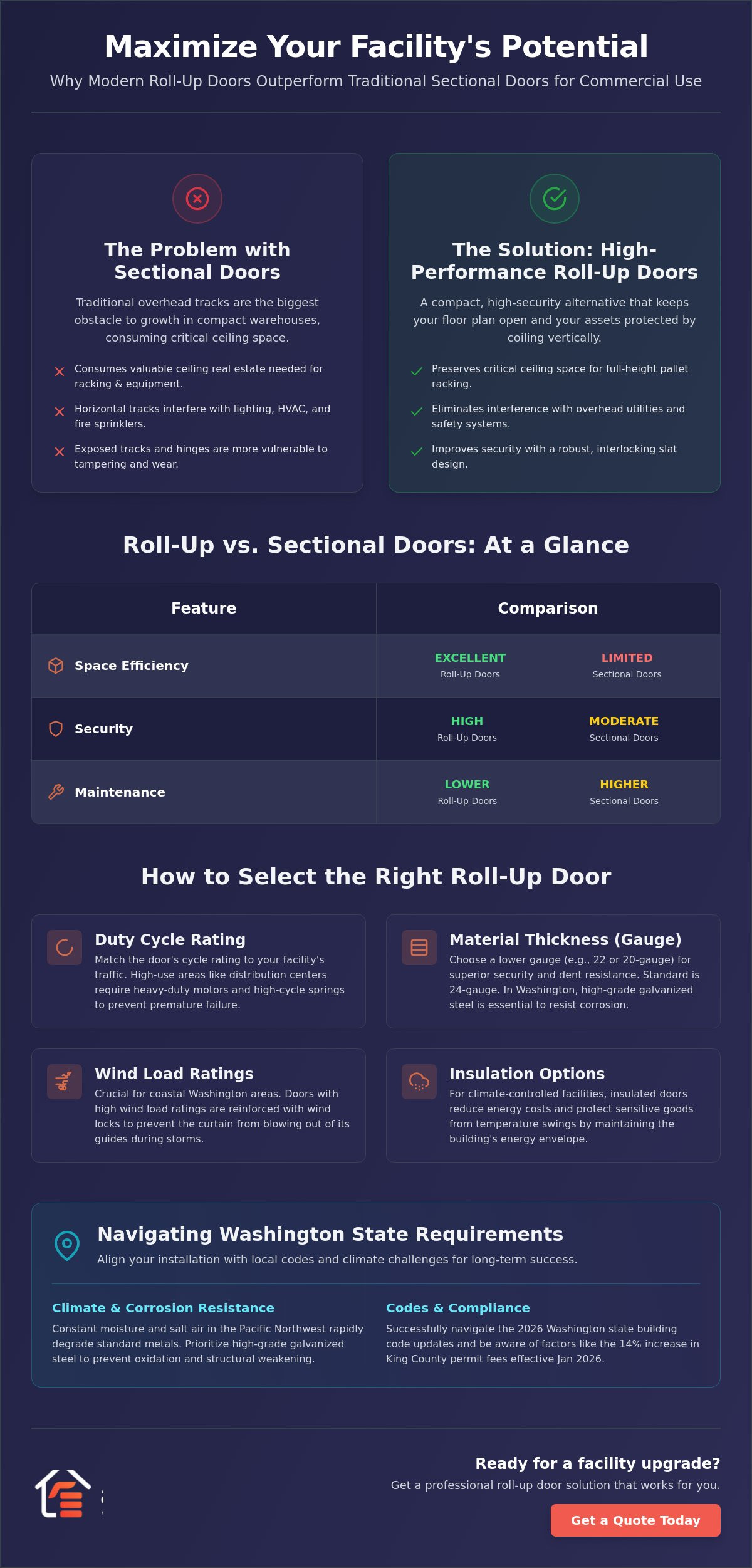
Unlike standard sectional doors that slide along horizontal tracks, roll-up doors consist of individual interlocking slats that coil around a drum. This vertical operation is the foundation for Understanding Roll-Up Garage Doors and why they’re the preferred choice for industrial settings. By rolling into a compact cylinder above the header, these systems provide a robust barrier without the complexity of bulky overhead hardware.
In the Pacific Northwest, constant moisture and salt air can rapidly degrade standard metal surfaces. For a reliable roll up garage door installation, we prioritize the use of high-grade galvanized steel. This zinc-treated material acts as a sacrificial layer against oxidation, preventing the structural weakening that often affects non-treated doors in damp Washington environments. It’s a practical choice for longevity and peace of mind in our local climate.
These systems are versatile enough to handle a wide range of commercial applications. You’ll find them securing self-storage facilities, protecting loading docks in Everett warehouses, and providing high-security barriers for retail storefronts in downtown Seattle. Because they lack the exposed tracks and hinges of sectional doors, they’re naturally more resistant to tampering and environmental wear.
For many facility managers, these doors are just one part of a multi-layered security approach. To learn how to further harden your property’s exterior, you can find out more about Residential and Commercial Fence Installation as a way to enhance your site’s overall perimeter control.
The Mechanics of a Commercial Roll-Up System
The core of the system is the corrugated steel curtain. As the door opens, this curtain travels through vertical guides and coils around a barrel assembly. Internal torsion springs within the barrel provide the necessary counterbalance, making the door easier to lift. Depending on the frequency of use, businesses can choose between manual push-up handles, chain hoists for heavier curtains, or motorized operators for high-traffic zones. Motorized systems are particularly beneficial for facilities that need to maintain strict temperature controls or high security through rapid opening and closing cycles.
Why Space-Saving Design Matters for Your Facility
Every square foot matters in a warehouse or production facility. Traditional sectional doors require several feet of horizontal track, which often interferes with lighting fixtures, HVAC ductwork, and fire sprinkler systems. A professional roll up garage door installation eliminates these obstacles by keeping all mechanical components tucked away in a compact housing above the door opening. This configuration ensures that lighting remains unobstructed and fire suppression systems can operate without interference. It also allows business owners to utilize the full height of their walls for pallet racking, maximizing the return on their real estate investment.
Key Factors for Selecting the Right Roll-Up Door Model
Selecting the right door involves more than picking a size. You must evaluate the daily duty cycle, which refers to how many times the door opens and closes in a 24-hour period. A self-storage unit might only cycle once a week, while a busy distribution center could cycle dozens of times an hour. Choosing a door with an underspecified spring life leads to premature failure and operational downtime. For high-traffic facilities, investing in a heavy-duty motor and high-cycle springs during your roll up garage door installation ensures long-term reliability and lower maintenance costs over time.
Material thickness is another critical variable, typically measured in gauge ratings. A 24-gauge door is standard for many applications, but 22-gauge or 20-gauge options provide superior security and dent resistance. In coastal Washington areas or high-wind zones, wind load ratings are vital. These specialized doors are reinforced with wind locks to prevent the curtain from blowing out of its guides during a storm. Adhering to Professional Roll-Up Door Solutions ensures your installation meets these critical safety and performance benchmarks.
For businesses managing climate-controlled inventory, insulation is a necessity. Insulated roll-up doors use foam-in-place technology or foil-backed liners to maintain internal temperatures. This reduces energy costs and protects sensitive goods from Washington’s seasonal temperature swings. It’s a practical way to improve the building’s overall energy envelope while providing a quieter operational environment.
Sheet Doors vs. Slat Doors: Choosing Your Protection
Sheet doors are composed of a large, continuous corrugated steel curtain. They’re lightweight and cost-effective, making them perfect for light commercial use and storage facilities. Slat doors, often called service doors, consist of individual interlocking slats. This design offers maximum strength and superior collision resistance. If a forklift accidentally clips the door, a technician can often replace individual slats rather than the entire curtain. This makes slat doors the preferred choice for busy loading docks where minor impacts are a frequent risk.
Security Features and Locking Mechanisms
Security is a primary concern for any commercial facility, especially in high-traffic zones. Most systems include slide bolt locks on the interior bottom bar, but you can upgrade to cylinder locks for exterior access. High-security bottom bars are reinforced with heavy-duty angles to prevent prying or tampering. To ensure your facility remains protected, consider these common security upgrades:
- Slide Bolt Locks: Simple, effective interior locking for overnight security.
- Cylinder Locks: Keyed access from the exterior, ideal for retail storefronts.
- Tamper-Resistant Bottom Bars: Reinforced steel to prevent forced entry at the ground level.
- Access Control Integration: Connecting the door motor to your facility’s alarm or badge-entry system.
Modern facilities often integrate these doors with existing access control systems for remote monitoring. If you’re unsure which security level fits your building, you can request a professional site assessment to review your specific operational needs.
Roll-Up vs. Sectional Doors: Which is Right for Your Facility?
Most business owners eventually face a choice between sectional doors and coiling systems. Sectional doors are popular for their aesthetic variety and insulation properties; however, they require significant internal hardware. A professional roll up garage door installation is often the superior choice for high-traffic industrial environments where space and durability are the primary concerns. While sectional doors might offer a lower initial investment in some cases, the long-term maintenance requirements for their numerous hinges, rollers, and long-track systems can quickly offset those savings.
The speed of operation also differs significantly between these two styles. Roll-up doors are designed for rapid cycles, which is a critical factor for facilities that need to maintain strict climate control or high levels of security. Repairability is another major advantage for coiling systems. If a forklift strikes a sectional door, you often have to replace an entire large panel. With a slat-style roll-up door, a technician can simply replace the specific damaged slats, which significantly reduces both repair costs and facility downtime.
The Headroom and Backroom Comparison
Visualizing the “dead space” in your warehouse is the easiest way to understand the value of a roll-up system. Sectional doors require tracks that run horizontally into the building, creating a large area where you cannot install high-density racking, lighting, or HVAC ductwork. Roll-up doors eliminate this requirement entirely by coiling into a compact housing above the header. Reclaiming this square footage allows you to maximize your vertical storage capacity, which often provides a much higher return on investment than the cost of the door itself. It’s a strategic move for businesses in Everett or Seattle where warehouse space is increasingly expensive.
Operational Lifespan and Reliability
The internal components of these doors are built to different standards. Standard sectional doors often come with springs rated for 10,000 cycles, which can be exhausted quickly in a busy commercial setting. Commercial roll-up doors are typically engineered for 20,000 to 50,000 cycles, and some high-performance models go even higher. Duty-cycle is the primary metric used to determine the operational longevity of a commercial door system. Because coiling mechanisms have fewer exposed moving parts than sectional rollers and hinges, they generally require less frequent adjustments to remain in peak working order. This reliability ensures your facility stays operational without the stress of unexpected mechanical failures.
Technical Requirements for a Successful Roll-Up Door Installation
Precision is the foundation of a reliable commercial door system. Unlike residential projects, a roll up garage door installation for an industrial facility involves heavy-duty components that must be aligned to within a fraction of an inch. If the structural mounting surfaces are uneven or the measurements are slightly off, the door will experience “coning” or uneven tracking. This lead to premature curtain fatigue and eventual mechanical failure. Ensuring the header is structurally sound and capable of supporting the full weight of the barrel assembly is the first step in any professional project.
Headroom and sideroom requirements vary based on the specific door model and height. Generally, you’ll need between 12 to 24 inches of headroom above the opening to accommodate the coiled curtain. Sideroom is equally important; the vertical guides typically require 4 to 8 inches of clear space on each side of the opening. If your facility has limited side clearance, specialized mounting brackets may be necessary to ensure the guides remain stable under the pressure of high-wind loads or frequent daily use.
The Precision of the Rough Opening
The rough opening must be checked for plumb and level jambs before any hardware is mounted. For a proper weather-tight seal, the door curtain is actually designed to be wider than the opening itself. This overlap ensures the guides can be mounted securely to the interior face of the wall. Technicians also account for floor pitch during this stage. If the concrete floor is uneven, the bottom bar won’t sit flush, which compromises the building’s security and thermal efficiency. A professional assessment identifies these issues early so they can be corrected before the door is hung.
Professional Installation vs. DIY Risks
Commercial doors utilize high-tension torsion springs that store an immense amount of energy. While many online resources focus on DIY methods, these are often intended for light residential doors and ignore the lethal risks associated with industrial-grade springs. One wrong move during the tensioning process can result in severe injury or significant property damage. Beyond the safety concerns, most manufacturers will void the warranty if the system isn’t installed by a certified technician. Professional leveling of the barrel assembly is also critical; even a minor tilt causes the slats to rub against the guides, which shortens the lifespan of the entire system. To protect your investment and your staff, it’s always best to schedule a professional door installation with an experienced team.
Professional Roll-Up Door Solutions in Washington
Securing a commercial facility requires a partner who understands the local operational landscape. Our team provides customized on-site estimates for businesses across the state, from the industrial corridors of Everett to the growing logistics hubs in Spokane. A successful roll up garage door installation is the first step in a long-term operational strategy. We offer expert advice on selecting the specific gauge and motor configuration that best suits your industry, whether you run a high-traffic distribution center or a quiet retail storefront.
Operational reliability depends on consistent care after the initial project is complete. We provide comprehensive safety inspections and preventative maintenance plans designed to identify wear before it leads to a breakdown. These programs include scheduled lubrication of the coiling mechanism, spring tension adjustments, and thorough testing of all safety sensors. By addressing minor issues early, we help you minimize unexpected downtime and extend the lifespan of your investment—a principle of specialized care you can also discover Euro Performance Auto Shop LLC applying to the maintenance of high-performance European vehicles.
When accidents happen, your facility’s security cannot wait. We offer emergency 24/7 garage door repair services to handle collision damage, broken springs, or motor failures at any hour. This rapid response ensures that your building remains protected and your workflow continues with minimal interruption. Our technicians arrive with the tools and parts necessary to stabilize your door and restore function quickly.
Local Expertise for Washington Commercial Properties
Washington’s building codes and fire safety requirements are specialized, particularly regarding the state-mandated heat detector amendments. We maintain fast response times for facilities in Seattle, Tacoma, and Auburn, ensuring that every roll up garage door installation complies with local regulations. Our experience spans diverse sectors, including heavy agriculture, urban retail, and large-scale logistics. This versatility allows us to navigate the specific structural challenges found in both historic Pacific Northwest warehouses and modern industrial parks.
Getting Started with Your Installation
The consultation process is designed to be methodical and transparent. It begins with a detailed site measurement and a review of your facility’s daily traffic patterns. We then provide a clear proposal that outlines the best material choices and operational features for your needs. Modern facility management often benefits from smart upgrades, which allow for remote monitoring and improved access control. These systems provide real-time data on door status and help property managers coordinate deliveries more efficiently. To begin your project, you can contact Affordable Garage Door Repair & Sales LLC for a professional estimate and a final walkthrough of your facility requirements.
Secure Your Facility with Expert Installation
Choosing the right entry system is a long-term investment in your building’s security and operational efficiency. By prioritizing a professional roll up garage door installation, you don’t just save valuable ceiling space; you ensure your facility meets the rigorous technical standards required for industrial safety. We’ve discussed how selecting the proper duty cycle and material gauge prevents premature failure, especially when navigating the specific moisture and regulatory challenges found in the Pacific Northwest.
Our expert technicians in Everett, Spokane, and Seattle are ready to help you transition to a more reliable system. We provide free professional on-site estimates to ensure every measurement is precise and every structural requirement is met. Whether you need a new door installation or 24/7 emergency service for an existing system, we’re here to serve as your dependable local partner. We focus on delivering stability and peace of mind through every phase of the project.
Schedule your free on-site commercial estimate today to optimize your facility’s footprint and protect your assets for years to come. Your business deserves a solution that’s as hard-working and resilient as your team.
Frequently Asked Questions
How much headroom is required for a commercial roll-up door installation?
Most commercial roll-up doors require between 12 and 24 inches of headroom above the lintel. This space is necessary to accommodate the curtain as it coils around the barrel assembly. If your facility has limited clearance, we can often utilize specialized low-headroom brackets or smaller barrel diameters to ensure a successful roll up garage door installation without compromising structural integrity.
Can a roll-up garage door be insulated for temperature-sensitive warehouses?
Yes, roll-up doors can be manufactured with high-performance insulation to support temperature-sensitive warehouses and cold storage facilities. These models typically feature foam-in-place polyurethane or foil-backed insulation liners that fit within the interlocking slats. This design helps maintain internal temperatures and reduces energy costs, which is particularly beneficial for Washington businesses dealing with significant seasonal weather shifts.
How long does a professional roll-up door installation typically take?
A standard commercial installation typically takes between four and eight hours to complete per door. This timeline assumes the rough opening is already prepared and the mounting surfaces are plumb and level. Larger industrial projects or those requiring complex motorized integrations may require additional time. We prioritize a methodical approach to ensure the spring tension and barrel leveling are perfectly calibrated.
Is a roll-up door more secure than a standard sectional garage door?
Roll-up doors generally offer superior security because they lack the exposed hinges and rollers found on sectional systems. The interlocking slat design creates a continuous steel curtain that is much more difficult to pry or penetrate. When combined with tamper-resistant bottom bars and heavy-duty slide bolt locks, these systems provide a high-strength barrier ideal for high-traffic commercial zones.
What is the difference between a manual and motorized roll-up door?
Manual doors operate via a push-up handle or a chain hoist, making them suitable for low-traffic areas or smaller openings. Motorized doors use electric operators to handle the heavy lifting, which is essential for high-frequency duty cycles. Motorized systems also allow for integration with safety sensors and remote access controls, which improves facility workflow and employee safety during daily operations.
How often should commercial roll-up doors be serviced in Washington?
Commercial doors in Washington should undergo a professional safety inspection at least once or twice a year. Our local climate’s moisture can accelerate wear on moving parts and torsion springs. Regular maintenance involves lubricating the guides, checking the spring tension, and verifying the balance of the door. This proactive care helps prevent unexpected mechanical failures and minimizes costly facility downtime.
What happens if my roll-up door curtain gets dented or damaged?
If your door is a slat-style service door, individual damaged slats can often be replaced without removing the entire curtain. This modular design makes repairs more cost-effective than sectional door panel replacements. However, if the door is a continuous sheet design, a significant dent may require replacing the whole curtain to ensure it still coils smoothly within the barrel assembly.
Are roll-up doors compatible with smart garage door openers?
Most motorized roll-up doors are fully compatible with modern smart garage door openers and monitoring systems. These upgrades allow property managers to monitor door status in real-time and manage facility access via smartphone apps. During a roll up garage door installation, we can integrate these smart controllers to provide your facility with enhanced security logs and remote operation capabilities.