What if the most dangerous component in your home is currently under hundreds of pounds of tension, just waiting for the right moment to snap? Most homeowners don’t think about their garage door hardware until a loud bang echoes through the house or the car is trapped inside on a busy Monday morning. It’s a stressful situation that often leads to safety concerns and unexpected repair needs. Understanding when to replace garage door springs is the most effective way to prevent these sudden failures and protect your property from avoidable damage.
You likely recognize that your garage door is a complex mechanical system, but the springs are its literal muscles. These components have a finite lifespan, typically rated for about 10,000 cycles, which can be reached faster than many people realize. In this guide, we provide a methodical approach to assessing your hardware. You will learn to identify visual fatigue, recognize the sounds of a failing system, and determine exactly when it’s time to bring in a professional to ensure your home remains safe and functional.
Key Takeaways
- Learn why the springs, not the opener, perform the heavy lifting and why this makes them the most critical point of failure in your system.
- Identify the seven primary warning signs, including visual gaps and the “heavy door” test, to accurately gauge when to replace garage door springs.
- Understand how your daily usage translates into “cycles” and why upgrading to high-cycle springs can significantly extend your hardware’s lifespan.
- Discover how the specific climate of the Pacific Northwest accelerates rust and affects the structural integrity of your garage door components.
- Recognize the safety risks associated with high-tension repairs and why professional-grade tools are required for a secure, long-term installation.
Understanding the Role of Garage Door Springs
Many homeowners assume the electric opener does the heavy lifting when a garage door moves. In reality, the opener acts as the brain of the system, while the springs provide the mechanical muscle. A standard garage door can weigh hundreds of pounds. Without a functional counterbalance system, the opener motor would burn out almost instantly under the strain. Garage door springs are high-tension steel components specifically engineered to offset this weight. They are wound or stretched to create a force equal to the weight of the door, allowing it to stay balanced and move with minimal effort.
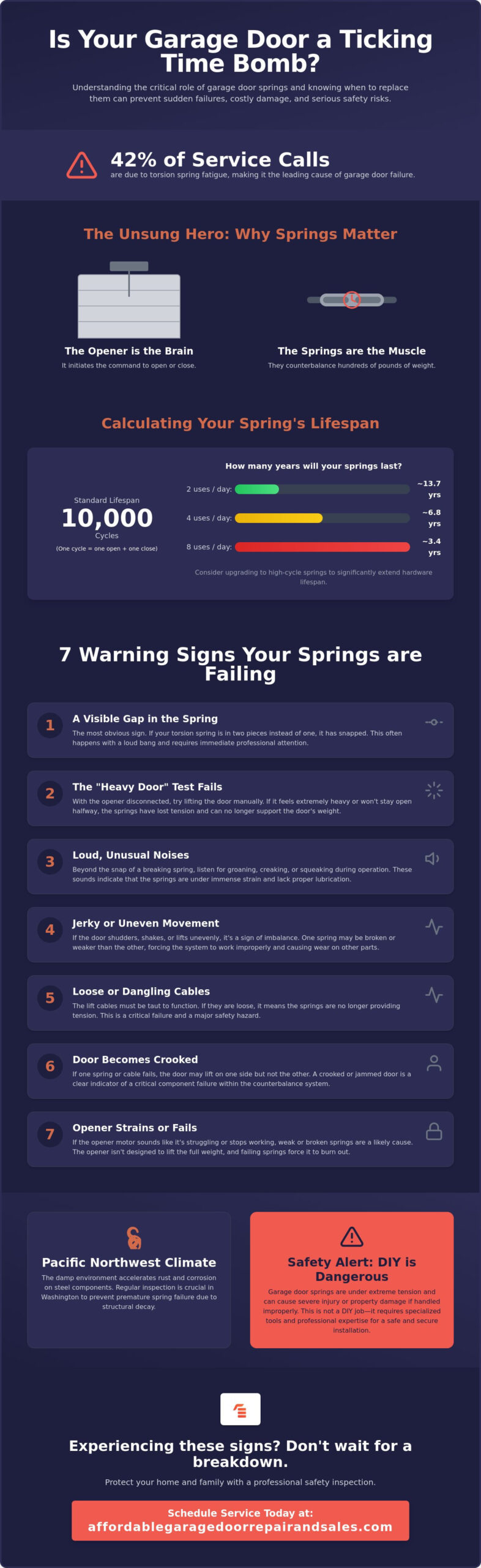
Every time you operate your door, the metal in the spring undergoes significant physical stress. This movement is known as a cycle. Most standard springs are designed for approximately 10,000 cycles. Over time, the constant twisting or stretching causes the steel to fatigue at a molecular level. This degradation is inevitable. It is the primary reason why knowing when to replace garage door springs is vital for long-term home maintenance. According to industry data, torsion spring fatigue is the leading cause of garage door failure, accounting for 42% of all service calls. When a spring reaches its limit, the metal becomes brittle and eventually snaps, often with enough force to damage the surrounding hardware or tracks.
Safety is the most critical consideration. A wound torsion spring holds an immense amount of energy. If the hardware is old or corroded, that tension can be released unexpectedly. Because these springs are under such high pressure, they can cause significant injury or property damage if they fail while someone is nearby. Monitoring the age of your hardware and planning for professional service before a total break occurs is the best way to maintain a safe environment.
Torsion Springs vs. Extension Springs
There are two primary types of garage door springs used in residential properties. Torsion springs are mounted on a metal shaft directly above the door opening. They use torque to balance the load, distributing weight more evenly across the entire system. Extension springs are typically found on older homes or in garages with limited headroom; they run along the upper tracks and stretch to provide lift. In Washington, torsion springs have become the modern standard because they offer superior control and generally last longer in our damp environment.
The Mechanics of Spring Tension
The physics of a garage door depends on stored energy. When the door is closed, the springs are under maximum tension. As the opener initiates the lifting process, the springs release that stored energy to assist the motor. If the spring wire gauge isn’t perfectly matched to the door’s weight, the balance is lost. An improperly tensioned spring forces the opener to work harder than intended. This extra strain can lead to a premature motor failure, turning a simple spring replacement into a much more expensive repair project.
The Checklist: 7 Warning Signs Your Springs are Failing
Identifying a failing component before it leads to a total system collapse is the most effective way to manage home maintenance costs. While some indicators are subtle, others are immediate and undeniable. Homeowners often ask when to replace garage door springs to avoid being stranded; the answer lies in a combination of visual inspections and performance tests. Understanding the difference between a pre-failure warning and a post-failure breakdown helps you prioritize repairs before they turn into emergencies.
The “Heavy Door” test is a primary diagnostic tool. To perform this, close the door and pull the emergency release cord to disconnect the electric opener. Attempt to lift the door manually. A well-balanced door should feel light and stay in place when opened halfway. If the door feels nearly impossible to lift or crashes back to the floor, the springs have lost their tension. Identifying these signs you need to replace your garage door spring early can prevent the door from becoming a significant safety hazard. If you notice this weight imbalance, a professional safety inspection is the most reliable next step.
Another critical sign is the presence of loose or dangling cables. This is a post-failure symptom that causes confusion for many homeowners. When a spring snaps or loses its elasticity, it no longer provides the tension required to keep the lifting cables taut on the drums. Consequently, the cables may slip off or hang loosely. This often results in the door becoming crooked or stuck in the tracks. Jerky or uneven movement during operation also suggests that one spring is providing more lift than the other, creating a dangerous imbalance that puts excessive strain on the rollers and tracks.
Audible Indicators of Metal Fatigue
The sounds your garage door makes provide valuable clues about its health. While minor squeaking is often solved with lubrication, persistent grinding or groaning indicates that the metal coils are struggling under the load. The most dramatic indicator is a loud, sudden bang from the garage. This “shotgun blast” sound occurs when a torsion spring snaps, releasing all its stored energy at once. If you hear this sound, do not attempt to operate the door, as the opener is now bearing the full weight of the door alone.
Visual Inspection Checklist for Homeowners
A quick visual scan can often confirm your suspicions. Look for these three specific physical markers:
- The Torsion Gap: A broken torsion spring will show a clear gap, usually one to two inches wide, where the coil has separated.
- Stretched Coils: On extension springs, look for areas where the coils no longer sit tightly together. If the spring looks elongated or “stretched out,” it has lost its structural integrity.
- Initial Hesitation: Observe the door as it begins to open. If it pauses or “stutters” during the first few inches of travel, the springs are likely exhausted and nearing the end of their functional life.
Calculating Your Spring Life Cycle
A garage door spring doesn’t measure its life in years; it measures it in cycles. One cycle consists of the door opening fully and then closing again. Most residential properties are equipped with standard torsion springs designed for approximately 10,000 cycles. While this sounds like a high number, daily life consumes these cycles quickly. Understanding your household’s specific usage patterns is the most accurate way to predict when to replace garage door springs before a critical failure occurs.
In Washington, regional environmental factors also play a role in metal fatigue. Residents in Eastern Washington experience extreme temperature swings that cause steel to expand and contract significantly. In Western Washington, the persistent humidity can lead to surface rust; this weakens the wire’s structural integrity. Because both springs on a double door were likely installed at the same time, they share the same cycle count. If one snaps, the other is statistically certain to fail shortly after. Replacing both simultaneously ensures consistent tension and prevents a second service call within a few weeks.
The Math of Garage Door Longevity
Typical households use their garage door roughly four times a day. At this rate, a standard 10,000-cycle spring will last approximately seven years. To estimate your hardware’s expiration, divide the total cycle rating by your average daily uses and then divide that result by 365. For high-traffic households where the door opens six to ten times daily, standard springs may fail in under four years. In these cases, upgrading to high-cycle springs, which are rated for 25,000 to 50,000 cycles, provides a much better long-term value.
The “Balance Test” Procedure
A simple balance test is the most effective way to monitor spring health between professional inspections. First, close the door and disconnect the electric opener by pulling the emergency release cord. Manually lift the door to the halfway point and let go. A properly tensioned door will stay in place or move only slightly. If the door falls, your springs are under-tensioned and exhausted. If it continues to fly upward, the tension is too high, which can damage the door’s top section. Performing this test every six months helps you catch the early stages of spring fatigue before the metal snaps.
Regional Factors: Washington State Climate and Spring Wear
Washington’s environment creates unique challenges for high-tension steel components. In Western Washington, the persistent humidity in unheated garages leads to the development of “flash rust.” This thin layer of oxidation creates unnecessary friction between the spring coils as they wind and unwind. Over time, this friction acts like sandpaper, thinning the wire and accelerating metal fatigue. This environmental stress is a primary factor in determining when to replace garage door springs, as a rusted spring is far more likely to snap prematurely than one kept in a dry, climate-controlled space. While standard springs in the Pacific Northwest typically last 8 to 10 years, environmental neglect can shorten that window significantly.
Homeowners in Eastern Washington cities like Spokane or Yakima face a different set of obstacles. These areas experience extreme temperature fluctuations that cause steel to expand in the summer and contract in the winter. This constant thermal cycling makes the metal brittle over several seasons. Research shows that 38% of garage door spring failures occur during the winter months of December through February. When the metal is cold and contracted, it becomes less pliable. The sudden tension of lifting a heavy door in freezing temperatures is often the final straw for a spring already nearing the end of its life cycle.
Combating Rust and Corrosion
For residents in coastal regions like Everett or Seattle, salt air is a constant threat to mechanical hardware. Salt corrosion is aggressive and can shorten a spring’s functional life by 30% to 50% compared to inland homes. You should distinguish between surface rust, which can often be treated, and deep pitting in the steel. Pitting indicates that the corrosion has moved into the core of the wire, compromising its structural integrity. To mitigate this, apply a high-quality silicone-based lubricant to the coils every three to four months. Avoid using standard WD-40; it acts as a cleaner rather than a durable lubricant and can actually strip away protective coatings. If you notice deep pitting or orange discoloration, it is wise to book a safety inspection to evaluate the risk of failure.
Seasonal Inspections in the PNW
The transition into the first cold snap of autumn is the most common time for older hardware to fail. Beyond the temperature change, Washington’s wet winters often cause the bottom rubber seal of the door to freeze to the driveway. When the opener attempts to lift a frozen door, it adds immense “dead weight” to the system. This extra load can cause a weakened spring to snap instantly. Performing a visual check and clearing ice from the base of the door can prevent these high-stress failures during the winter months.
Professional Replacement: Safety and Expert Solutions
While digital tutorials often portray spring replacement as a manageable weekend project, the reality involves managing hundreds of pounds of explosive tension. One slip with an improper tool can lead to life-altering injuries or significant property damage. Professional technicians utilize a specialized kit designed for high-tension environments. This category of equipment includes high-grade steel winding bars for controlled tensioning, torsion gauges for weight verification, and professional-grade winding cones that secure the spring to the shaft. This technical competence ensures the energy within the coils is handled with absolute control, providing a level of safety that a DIY attempt simply cannot match.
Choosing when to replace garage door springs often comes down to a choice between a temporary fix and a long-term solution. A professional installation pays for itself by preventing secondary damage to the tracks and the opener motor. When a technician replaces your hardware, they don’t just swap a part; they perform a comprehensive system calibration. This includes verifying the cable tension, lubricating the rollers, and ensuring the sectional panels are perfectly aligned. This methodical approach ensures the system operates reliably for its full 10,000-cycle rating, giving you the peace of mind that your door will open every time you press the button.
Why Precision Calibration Matters
Precision is the foundation of a functional garage door system. Every door has a specific weight profile based on its material—whether it is heavy carriage-house wood or lightweight insulated steel. The spring wire gauge and coil length must be perfectly matched to this square footage. If the springs are even slightly off-balance, it creates a “heavy door” scenario that forces the electric opener to work beyond its intended capacity. Affordable Garage Door Repair & Sales LLC ensures every installation is perfectly balanced, which eliminates the risk of premature opener burnout and keeps the door moving smoothly along its tracks.
Booking Your Service in Washington
We understand that a broken spring is more than a mechanical failure; it is a major disruption to your daily routine. Our team provides emergency 24/7 garage door repair for residents across the state, including Everett, Seattle, and Spokane. During a professional service visit, our technicians conduct a thorough safety inspection and spring tune-up to identify wear before it leads to a total breakdown. This proactive service is designed to lower your stress and provide clear, organized solutions to practical mechanical problems. Schedule your free on-site estimate today to restore the stability and safety of your home entry.
Secure Your Home with Proactive Maintenance
We’ve explored how a balanced door depends entirely on the integrity of your hardware and why Washington’s unique climate requires consistent vigilance. By tracking your daily usage cycles and performing a simple balance test every six months, you can stay ahead of sudden mechanical failures. Maintaining a safe and functional home means knowing exactly when to replace garage door springs before they compromise your entire entry system.
Our team provides 24/7 emergency service across Washington to handle snapped hardware whenever a crisis occurs. We employ highly trained technicians who specialize in both torsion and extension springs, ensuring every repair is calibrated to your door’s exact weight and material. You can rely on us for free on-site estimates and comprehensive safety inspections to identify wear before it leads to a breakdown. Get a Free Estimate on Professional Spring Replacement today. Restoring the reliability of your garage door is a straightforward process that brings long-term peace of mind to your household.
Frequently Asked Questions
Can I replace just one garage door spring if the other is still okay?
You should always replace both springs at the same time. Because both springs have undergone the same number of cycles, the unbroken one is statistically likely to fail shortly after the first. Replacing them as a pair ensures your door stays perfectly balanced and prevents the need for a second service call just weeks later. This approach provides long-term stability for your entire garage door system.
How much does it usually cost to replace garage door springs in Washington?
The cost for spring replacement in Washington depends on the door’s weight and the specific type of spring required. Torsion springs generally involve a higher investment than extension springs due to their durability and specialized installation process. Factors such as emergency after-hours service or high-cycle hardware upgrades will also influence the final total. Professional technicians provide detailed on-site estimates based on your specific door material and hardware needs.
How long should I expect my garage door springs to last?
Standard garage door springs are engineered for approximately 10,000 cycles, which usually translates to seven to ten years of service for the average household. If your family uses the garage door more than four times a day, this lifespan will decrease. Environmental factors like the humidity in Western Washington can also impact longevity. High-cycle options are available that can double or even triple this duration for high-traffic homes.
What is that loud bang I heard in my garage even though nothing seems broken?
That loud bang is almost certainly the sound of a spring snapping under high tension. When the steel coils finally yield to metal fatigue, they release their stored energy instantly. Even if the door appears functional at first glance, you should check the torsion shaft above the door for a visible gap in the coils. Operating the door with a broken spring puts dangerous levels of stress on your opener motor.
Is it safe to open my garage door manually if the spring is broken?
Opening a garage door manually with a broken spring is generally unsafe and not recommended. Without the counterbalance provided by the springs, you are attempting to lift the full dead weight of the door, which can be several hundred pounds. This can lead to the door crashing down unexpectedly or causing serious physical strain. If your car is stuck inside, it is best to wait for a professional with the proper lifting equipment.
Can I use a larger spring to make my garage door open faster?
You cannot use a larger spring to increase the opening speed of your door. Springs must be precisely matched to the weight and height of your door to maintain a safe counterbalance. Installing an oversized spring will cause the door to fly upward with dangerous force, while an undersized one will prevent it from opening at all. Opening speed is a function of the opener motor, not the spring tension.
What is the difference between standard and high-cycle springs?
The primary difference lies in the thickness and quality of the steel wire used in the manufacturing process. Standard springs are designed for 10,000 cycles, whereas high-cycle springs are engineered for 25,000 to 50,000 cycles. Choosing high-cycle hardware is a proactive way to manage when to replace garage door springs in the future. This upgrade is especially beneficial for households that use the garage as their primary home entrance.
How often should I lubricate my garage door springs to prevent rust?
You should lubricate your springs every three to four months to prevent rust and reduce friction between the coils. In the damp Pacific Northwest climate, this maintenance is essential for protecting the steel from oxidation. Use a silicone-based lubricant or a specialized garage door spray rather than heavy grease or standard WD-40. This simple task can extend the life of your hardware and keep the operation quiet and smooth.