In 2026, a commercial garage door inspection is no longer just a routine safety task; it’s a data-driven strategy to eliminate the leading cause of facility downtime. You likely feel the pressure of maintaining a seamless operation while juggling shifting UL 325 standards and the constant threat of liability claims. It’s frustrating when an unexpected equipment failure halts your entire supply chain, especially when you’re trying to keep your Washington facility within the 2026 fiscal year budget.
We understand that the line between in-house maintenance and professional requirements often feels blurry. This guide will help you master the essential safety protocols and inspection requirements to keep your operations compliant and efficient. You’ll gain a clear, manageable schedule that reduces repair costs through proactive care. We’ll examine the latest NFPA 80 standards, clarify the role of smart technology in predictive maintenance, and provide a roadmap to ensure your facility remains a safe and productive environment for everyone involved.
Key Takeaways
- Understand why neglecting a routine commercial garage door inspection can lead to significant liability risks and costly inventory damage.
- Identify critical mechanical warning signs by focusing on structural integrity and the high-tension components of the counterbalance system.
- Develop a balanced maintenance strategy that empowers warehouse staff with daily visual checklists while reserving complex adjustments for professional technicians.
- Learn how to combat Washington-specific environmental challenges, from Puget Sound salt corrosion to the extreme temperature shifts in Eastern Washington.
- Gain a clear roadmap for achieving full safety compliance and reducing operational downtime for the 2026 fiscal year.
Why Commercial Garage Door Inspections Are Critical for Washington Businesses
A commercial garage door inspection is a systematic and methodical evaluation of the structural, mechanical, and safety components that keep your facility’s entry points functional. This process goes beyond a simple visual check. It involves a detailed assessment of high-tension springs, motor cycles, and alignment precision. For facility managers in Washington, these inspections are the primary defense against the high cost of negligence. Failing to maintain these heavy systems carries immense risks, including severe injury liability and significant inventory damage if a door collapses or fails to close securely.
Operational uptime depends entirely on your ability to move goods in and out of your building. When a high-traffic sectional door fails, your entire supply chain can grind to a halt. A single stuck door creates a bottleneck that prevents shipments from leaving and stops deliveries from arriving. As we move through the 2026 fiscal year, the industry shift toward predictive care has made it clear that preventative maintenance is much more affordable than emergency repairs. While emergency service often requires premium labor rates and expedited parts, a scheduled inspection allows you to address minor wear before it becomes a catastrophic failure. Understanding The Technical Anatomy of a Professional Commercial Door Inspection helps managers recognize that small adjustments today prevent total system collapses tomorrow.
OSHA and ANSI Compliance Standards
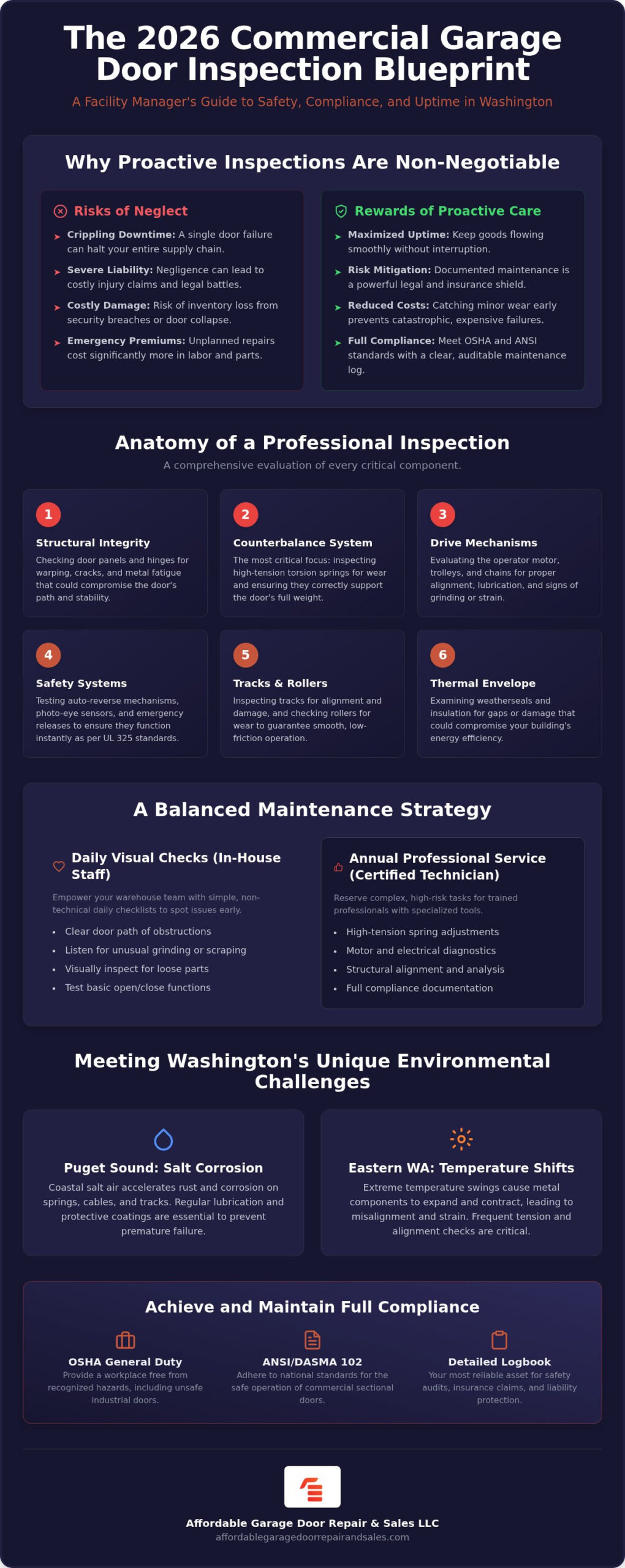
Compliance isn’t optional for modern industrial facilities. OSHA utilizes the “General Duty Clause” to ensure employers provide a workplace free from recognized hazards, which directly includes the operation of heavy industrial doors. Specifically, ANSI/DASMA 102 standards outline the requirements for commercial sectional doors to ensure they operate within safe parameters. You must maintain detailed documentation of every commercial garage door inspection for safety audits and insurance purposes. If an inspector or insurance adjuster requests proof of maintenance, a dated logbook of professional service is your most reliable asset.
Liability and Risk Mitigation for Property Managers
Documented inspections serve as a vital legal shield for property managers and owners. When you can prove that a door was professionally inspected and maintained according to industry schedules, you significantly reduce your exposure to personal injury claims. Many insurance providers now offer premium benefits or lower deductibles for facilities that can demonstrate a consistent, planned maintenance program. The professional standard of care for commercial door owners requires the proactive identification and resolution of mechanical hazards through regular, documented technical evaluations to ensure the safety of all facility occupants. By prioritizing these checks, you protect your staff, your assets, and your bottom line from the unpredictable nature of mechanical fatigue.
The Technical Anatomy of a Professional Commercial Door Inspection
A thorough commercial garage door inspection examines more than just the surface of the door panels. It requires a deep dive into the mechanical stresses that industrial equipment faces daily. Structural integrity begins with the panels and hinges. Over time, high-cycle usage leads to panel warping and hinge fatigue, which can compromise the entire door’s path. If a hinge cracks or a panel loses its rigidity, the door may bind in the tracks, putting excessive strain on the motor and increasing the risk of a sudden mechanical failure.
The counterbalance system is the most critical area of focus. Torsion springs are designed to support the full weight of the door, making them the most dangerous components to handle. During an inspection, technicians look for signs of metal fatigue that indicate a spring is nearing the end of its life cycle. Following DASMA’s inspection guidelines ensures that every high-tension part is evaluated against industry safety standards. If you suspect your springs are losing their tension, it is vital to schedule a professional safety inspection to prevent a total system collapse.
Drive mechanisms and thermal protection also require precise attention. The operator, trolleys, and chains must be lubricated and aligned to prevent grinding. Beyond the moving parts, we evaluate the building’s thermal envelope by checking weatherseals and insulation. A damaged bottom seal or worn perimeter weatherstripping allows conditioned air to escape, which significantly increases energy costs in large warehouse spaces.
Springs, Cables, and Torsion Shafts
Technical failures often start with invisible issues like hydrogen embrittlement. This occurs when moisture or chemicals cause high-cycle springs to become brittle and snap without warning. We also examine lifting cables for any signs of fraying. Industry safety protocols dictate that a cable with a 10% wear rate requires immediate replacement to avoid a “door drop” scenario. Additionally, we check bearing and shaft alignment. Misaligned bearings are the silent killers of motor life, as they create friction that forces the operator to work twice as hard.
Safety Features and Photoelectric Sensors
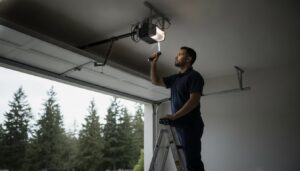
Safety systems are the final line of defense for your staff. We perform the standard 2×4 safety test to ensure the auto-reverse mechanism triggers immediately upon hitting an obstruction. Photo-eye sensors are also checked for alignment and lens clarity, as dust buildup in industrial environments is a common cause of intermittent failure. Finally, we test edge sensors and emergency manual releases to guarantee that your team can safely operate the door during a power outage or motor malfunction.
Inspection Frequency: Daily Checklists vs. Annual Professional Service
Effective facility management requires a tiered approach to equipment care. While a professional commercial garage door inspection provides a deep technical analysis, your on-site team is the first line of defense against operational failure. Empowering warehouse staff to perform a “Daily Visual” ensures that obvious issues, such as bent tracks or obstructed sensors, are addressed before they cause an accident. This daily attention creates a culture of safety and prevents minor obstructions from escalating into costly mechanical damage.
Your internal maintenance team can safely handle basic housekeeping tasks, but they must recognize the boundaries of their technical training. It is vital to distinguish between general facility upkeep and specialized mechanical service. For instance, while staff can clear debris from tracks, they should never attempt to adjust high-tension components. Maintaining a detailed maintenance log is essential for satisfying safety inspectors and insurance adjusters. This log should document every check, from daily visuals to monthly walkthroughs, providing a clear paper trail of your commitment to safety.
The In-House Monthly Safety Walkthrough
A monthly walkthrough is more detailed than a daily check. During this time, your maintenance lead should inspect all visible hardware for loose bolts or worn rollers. Listen closely to the door as it operates. Red flag noises like heavy grinding usually indicate bearing failure, while high-pitched squeaking often points to a lack of lubrication. When applying lubricant, avoid heavy automotive grease. In industrial environments, thick grease attracts dust and grit, which creates an abrasive paste that wears down components. Use a light, manufacturer-recommended silicone or lithium spray to keep parts moving freely without attracting debris.
Professional Tune-Ups and Safety Certifications
The “Annual Professional Deep-Dive” covers what the human eye often misses. Certified technicians use specialized tools to measure spring tension and motor draw, ensuring the system isn’t overworking. Adjusting spring tension is a high-risk task that should never be performed by untrained personnel. If an inspection identifies a fault, immediate commercial garage door repair is necessary to restore full functionality and safety. Upon completion, you’ll receive a Certificate of Inspection. This document is a valuable asset for facility resale or leasing, as it proves the equipment meets 2026 safety standards and has been maintained with a professional standard of care.
Washington State Factors: Weather, Salt, and Regional Needs
Washington’s diverse geography requires a tailored approach to a commercial garage door inspection. In the Puget Sound region, facilities in Seattle and Tacoma face constant salt-air exposure, which accelerates oxidation on metal tracks, rollers, and fasteners. Conversely, Eastern Washington businesses in Spokane must manage extreme temperature swings and high levels of fine dust. This dust can act as an abrasive within roller bearings and track systems, necessitating more frequent lubrication cycles than a standard coastal facility might require to maintain smooth operation.
Wind-load requirements are another critical regional factor, particularly for warehouses located in high-wind corridors like the Columbia River Gorge or coastal plains. If a door lacks the proper structural bracing for these zones, a severe storm can cause the panels to buckle or blow out entirely, leaving your inventory exposed. Additionally, the pervasive moisture in Western Washington poses a silent threat to smart-opener electronics. High humidity can corrode circuit boards and cause photoelectric sensors to malfunction, leading to intermittent operational failures that disrupt your facility’s flow.
Corrosion Prevention in Coastal Facilities
Coastal facilities should prioritize stainless steel or high-grade galvanized hardware to ensure long-term durability in high-moisture zones. Salt-air environments make frequent track cleaning essential, as mineral buildup creates friction that forces the motor to work harder. For facilities located in Everett, we recommend a professional inspection cadence of at least twice per year to mitigate the rapid effects of coastal corrosion. This proactive schedule allows for the early detection of surface rust before it compromises the structural integrity of the lifting cables or bottom brackets.
Preparing for Washington Winters
Freezing temperatures significantly alter lubricant viscosity, causing it to thicken and resist movement. This change creates additional motor strain, which often leads to operator failure during the first major cold snap of the season. It is also vital to maintain seal integrity to prevent “ice-bind,” a condition where the bottom garage door panel freezes directly to the concrete floor. If a door becomes stuck, attempting to force it open can snap cables or damage the motor gears. Ensuring you have a plan for emergency garage door repair access during snow events is a vital part of winter readiness for any Washington business. To protect your investment from these unique environmental stresses, schedule a commercial garage door inspection with our expert team before the winter season peaks.
Choosing Affordable Garage Door Repair & Sales for Your Inspections
Selecting a partner for your commercial garage door inspection requires more than just finding a technician; it requires a local ally with the scale to handle diverse facility needs across the Pacific Northwest. Affordable Garage Door Repair & Sales LLC maintains a strong presence from Everett to Yakima and Spokane, ensuring that professional support is always within reach. We understand that your time is valuable. Our technicians arrive in fully equipped service vehicles, which allows us to not only identify mechanical faults but also resolve them on-site. This comprehensive approach eliminates the need for multiple service appointments and minimizes the time your equipment is out of commission.
Transparency is a cornerstone of our service model. We provide clear, itemized estimates and detailed safety documentation for every visit. This level of reporting is vital for maintaining your facility’s compliance with 2026 safety standards. Our brand promise centers on providing cost-effective maintenance that protects your bottom line. By investing in regular preventative care, you avoid the high costs associated with catastrophic equipment failure and emergency labor rates. We focus on the longevity and resilience of your systems, ensuring you receive the best value over the life of your doors. Our team acts as a community anchor, providing the stability and peace of mind you need to focus on your core business operations.
Our 24/7 Emergency Commercial Support
Business operations don’t always follow a standard schedule. When an off-track door or a broken spring occurs in a high-traffic Seattle warehouse, the resulting downtime is immediate and costly. Our 24/7 emergency support team is designed for rapid response. We maintain a fleet of trucks ready for immediate commercial garage door repair at any hour. By prioritizing these urgent calls, we help you maintain your operational flow and secure your facility without delay. Our goal is to minimize business interruption through same-day service and reliable mechanical resolutions that stand up to industrial use.
Custom Maintenance Plans for WA Property Managers
Every facility has unique requirements based on its cycle counts and environmental exposure. We offer scalable maintenance solutions that cater to everything from small retail storefronts to massive regional distribution centers. Our experts provide objective advice on when to continue repairs and when it is time for a new garage door installation. If a system has reached the end of its functional life, we help you select a replacement that meets current wind-load and thermal requirements. Contact us today for a free on-site commercial estimate to secure your facility for the 2026 fiscal year and beyond.
Securing Your Facility’s Future for 2026
Managing a modern Washington facility requires balancing operational speed with strict safety standards. By integrating a regular commercial garage door inspection into your annual budget, you transition from reactive repairs to a proactive strategy that protects your team and your bottom line. You’ve learned how to identify technical warning signs and how to combat the unique environmental challenges of the Pacific Northwest, from Puget Sound salt air to Eastern Washington temperature extremes.
Reliability is built on consistent care and professional expertise. We provide 24/7 emergency service and free on-site estimates for new door installations to keep your business moving without interruption. Our expert technicians serve Seattle, Everett, Spokane, and the surrounding regions with the precision and care your facility deserves. Schedule your professional commercial door inspection with Affordable Garage Door Repair & Sales today! Let’s work together to ensure your facility remains safe, efficient, and fully compliant throughout the coming year.
Frequently Asked Questions
How often is a commercial garage door inspection required by law?
National standards like NFPA 80 require an annual inspection for all fire-rated commercial doors. For non-fire-rated doors, OSHA utilizes the General Duty Clause to ensure employers maintain equipment in a safe working condition. While specific intervals vary by usage, industry best practices and DASMA guidelines recommend a professional commercial garage door inspection at least once every twelve months to maintain safety compliance and operational efficiency.
Can my own maintenance team perform a commercial safety inspection?
Your internal team is capable of performing daily visual checks and basic track cleaning, but they shouldn’t handle technical adjustments. Professional inspections involve measuring spring tension and evaluating motor draw, which require specialized tools and training. Relying on certified technicians for your commercial garage door inspection ensures that high-tension components are handled safely and that your documentation meets the requirements for insurance and safety audits.
What are the most common signs that a commercial door is about to fail?
Common warning signs include excessive grinding noises, slow operational cycles, or a door that appears uneven when moving. You should also watch for frayed lifting cables or springs that show signs of significant rust or gaps. If the door reverses without a clear obstruction or hesitates during the opening phase, the motor or counterbalance system is likely reaching a point of critical fatigue.
How long does a professional commercial door inspection take?
A standard professional inspection typically takes between 45 and 90 minutes per door. This timeframe depends on the size of the door, the complexity of the operator system, and the accessibility of the high-tension components. Larger sectional doors or high-speed roll-up doors in distribution centers may require additional time to thoroughly test all safety sensors and mechanical cycles.
What is the difference between a residential and commercial safety inspection?
Commercial inspections are significantly more rigorous due to the extreme weights and high cycle counts of industrial equipment. While residential checks focus on basic photo-eye alignment, commercial evaluations must account for strict UL 325 standards and heavy-duty hardware. Commercial systems also face higher regulatory oversight, requiring detailed documentation that isn’t typically necessary for a standard home garage door.
Does a commercial garage door inspection include the opener and electronics?
Yes, a comprehensive inspection evaluates the entire drive system, including the motor, circuit boards, and all safety electronics. Technicians test the auto-reverse mechanism and photoelectric sensors to ensure they meet the 7th edition of the UL 325 standard. We also check the emergency manual release and edge sensors to guarantee the door remains controllable during a power failure or electronic malfunction.
What happens if my door fails an inspection?
If a door fails, the technician will provide a detailed report outlining the specific safety or mechanical faults discovered. Critical failures that pose an immediate risk of injury or property damage may require the door to be locked out until repairs are completed. You’ll receive a clear estimate for the necessary parts and labor to restore the system to a compliant and safe operating state.
Are there specific Washington state regulations for warehouse door safety?
Washington follows the International Building Code (IBC), which includes specific wind-load requirements for facilities in high-wind corridors or coastal areas. These regulations ensure that warehouse doors can withstand regional pressure extremes without structural failure. Additionally, state labor and industry standards require that all garage door installations and major repairs are performed under the appropriate permits to ensure long-term safety and code compliance.